

Recently the LHCb collaboration published two papers reporting the use of Artificial Intelligence (AI) in the study of top quark and Higgs boson production. The use of AI allowed LHCb physicists to study top and Higgs decays into lighter quarks. Quarks are not observed directly in particle detectors; instead they fragment into collimated sprays (called jets) composed of other particles which are then detected in the experimental apparatus. It is very difficult to measure precisely properties of these jets in presence of large number of other particles emerging from high energy proton-proton collisions at the LHC. A real breakthrough came with the use of AI in the form of machine learning, particularly deep learning, in jet physics in ATLAS and CMS, see for example this CERN news. This breakthrough enabled measurements which were previously not foreseen to be possible.
Machine learning (ML) is a field of study in AI concerned with the development and study of statistical algorithms that can learn from data and be generalised to analyse unseen data. Within ML algorithms, deep learning using neural networks (NN), inspired by the structure and functions of biological neural networks, is particularly efficient. A NN consists of connected units or nodes called artificial neurons, which loosely model the neurons in the brain. Typically, neurons are aggregated into layers. Different layers may perform different transformations on their inputs. Signals travel from the first layer (the input layer) to the last layer (the output layer), possibly passing through multiple intermediate layers (hidden layers). A network is typically called a deep neural network if it has multiple hidden layers. The 2024 Nobel Prize in Physics was awarded jointly to John J. Hopfield and Geoffrey Hinton “for foundational discoveries and inventions that enable machine learning with artificial neural networks”.
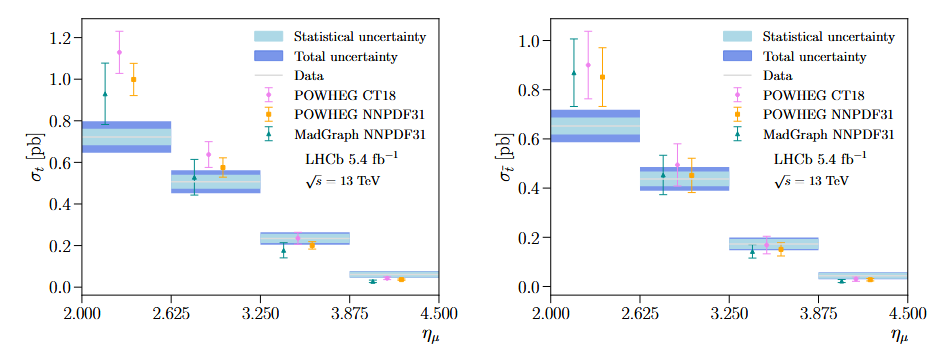
It is even more challenging to perform this kind of physics measurements in the forward region where the LHCb detector operates. This is because the density of particles is higher than in the central acceptance region explored by ATLAS and CMS. Two new papers demonstrate that LHCb is entering the same game. The plots above show results of differential cross-sections measurements using AI for the top quark (left) and anti-top quark (right) decays as function of muon pseudorapidity. LHCb has also been able to measure the top quark charge asymmetry, an important property of the top quark that can provide valuable insights into possible effects of physics beyond the Standard Model. The decays containing muon plus a b-jet were used in the corresponding measurements. The new study shows also how AI techniques can significantly enhance the reconstruction of the Higgs decay into two quarks. These advances open the way for LHCb to realistically aim at measuring the properties of the Higgs boson during the High-Luminosity phase of the LHC.
Further information can be found in the LHCb top and Higgs papers.