

Since March 30, the LHC accelerator has been operating in a special configuration, providing a lower collision rate to ATLAS and CMS than usual. This allows these experiments to complement their physics programmes, targeting a range of additional precision measurements.
In this configuration, the so-called “burn-off” of the beams is much slower than usual, resulting in long periods of stable beams (known as “fills”). Typically, a fill lasts around 12–14 hours, but under these conditions, fills can extend over several days.
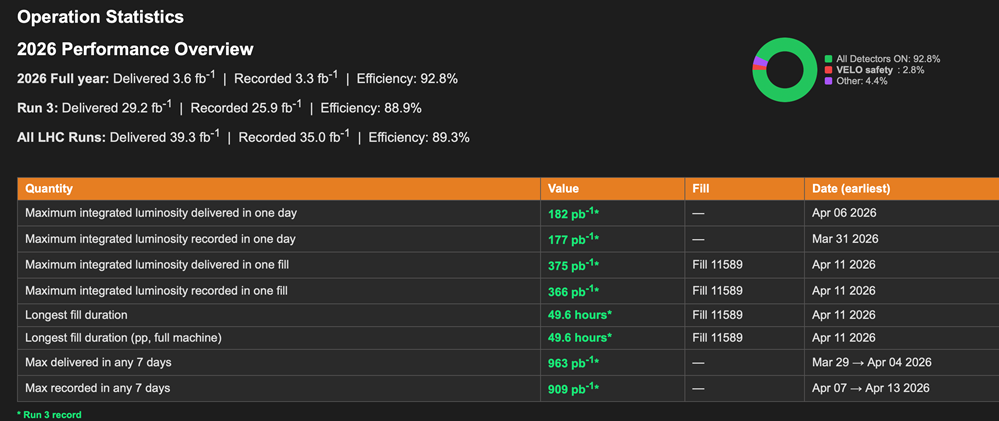
LHCb, which is operating at its normal collision rate, has had an opportunity to collect a record amount of data and has taken full advantage. So far, the longest fill has lasted almost 50 hours, during which LHCb accumulated a record 366 pb⁻¹. To put this into context, this exceeds the total collected during the entire 2015 data-taking year. This achievement is due not only to the extended fill duration, but also to LHCb operating with its upgraded detector from 2022. The upgraded detector operates with higher collision rates and a more efficient data acquisition system, greatly enhancing LHCb reach in precision physics and rare decays. The next upgrade, scheduled to be installed in 2034-5, is designed to take advantage of the high luminosity era of the LHC and will give a similar step up in performance.
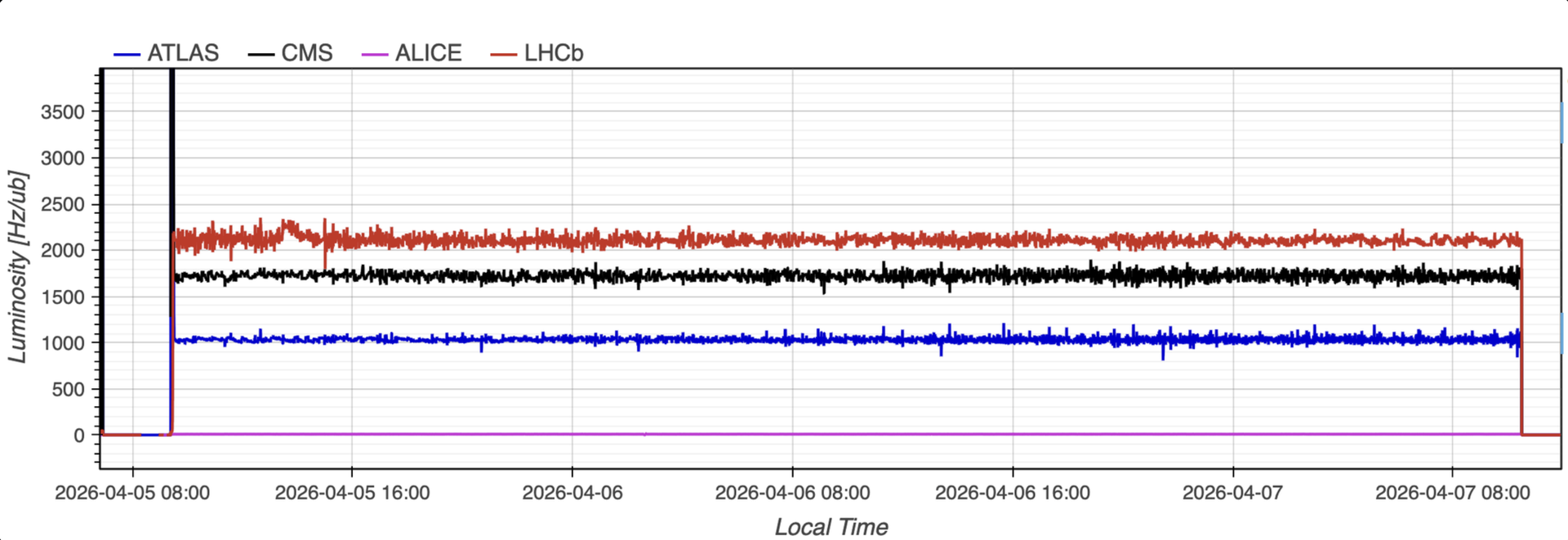
The special conditions are illustrated in the accompanying figures, which show the collision rates across the LHC experiments – currently highest for LHCb – as well as the LHCb Dashboard highlighting the record-breaking delivered and recorded luminosity for 2026.
This special run is expected to continue for several more weeks, and LHCb is already setting its sights on new records.