
One week ago the LHC dumped the beams for the last time this year, bringing the heavy ion run to an end. During this campaign, LHCb collected 0.86 nb⁻¹ of PbPb collisions, almost double the sample collected last year, thanks to improvements such as the enhanced β* = 1m optics. At the same time, the physics programme was expanded to cover 30% centrality by applying a looser global event cut. Centrality is an important concept in the study of heavy-ion collisions. It characterizes the size or amount of overlap of the fireball in the collision region. LHCb also accumulated its first sample of PbH2 fixed-target data, while significantly expanding the PbNe and PbAr fixed-target datasets.
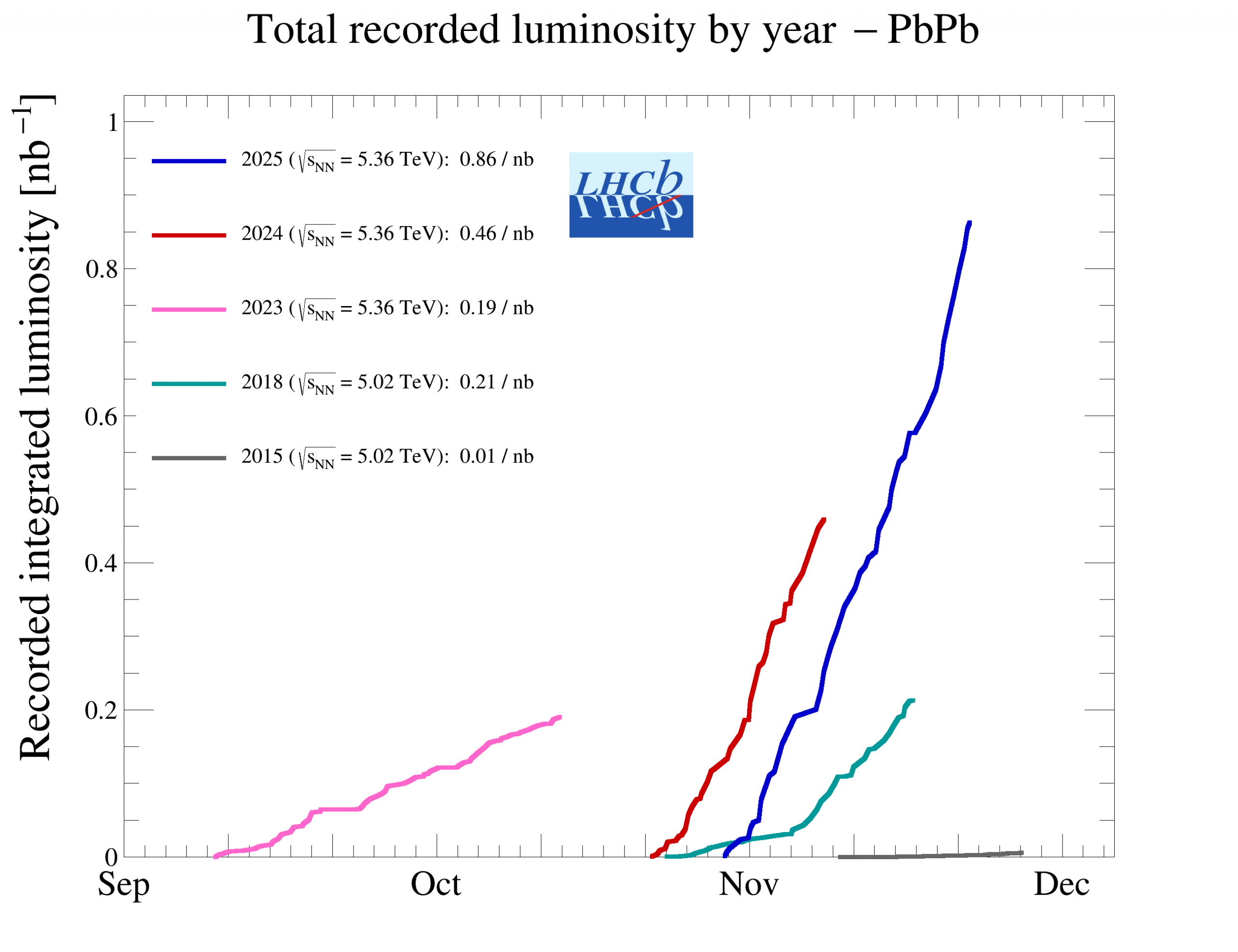
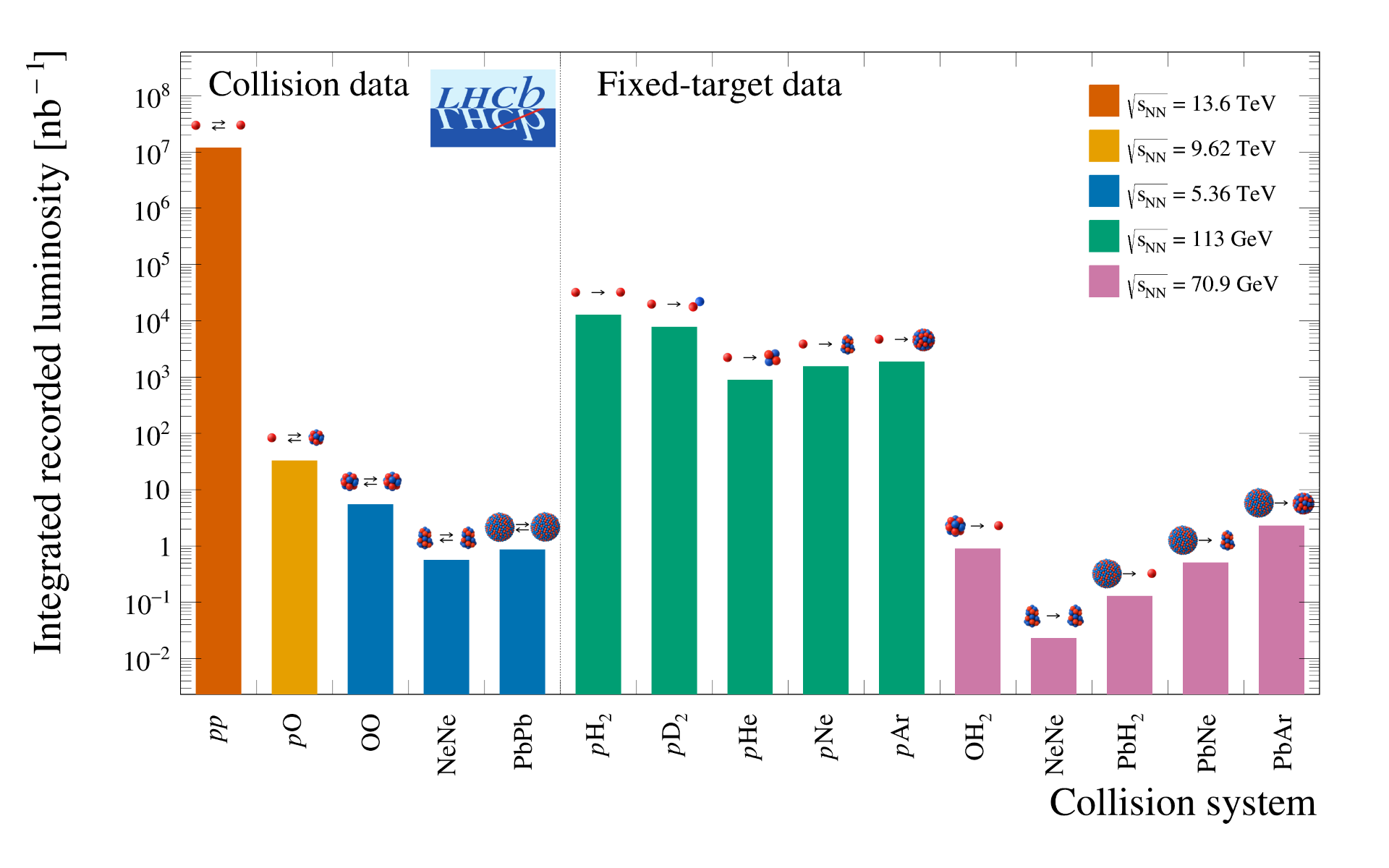
The plot on the left above shows the total recoded PbPb collision luminosity during different periods of data taking. The 2025 luminosity is the highest ever recorded. The plot on the right shows the recorded integrated luminosity for various colliding hadrons at the LHC, as well as for fixed-target collisions using SMOG2 system. This system allows collisions between particles from one of the LHC beams and the injected fixed-target gas particles to be recorded alongside standard LHC beam-beam collisions.
The proton-proton data taking period ended one month ago and was also very successful. LHCb collected 11.8 fb-1 of hight-quality data and achieved the highest ever recorded luminosity. See the 11 November news for details.
2025 was also the final full year of operation of the third run of the LHC, which began in July 2022. After a shorter-than-normal year-end technical stop at the end of the year, next year’s physics run is scheduled to begin in March and finish in June. After this, the LHC will enter a long shutdown period (LS3) while preparations are made for the High-Luminosity LHC (HL-LHC). This upgraded version of the LHC, scheduled for completion in 2030, will deliver approximately five times more particle collisions to the experiments.
These excellent performances from the LHCb experiment were obtained using the new Upgrade I detector which was completed in 2023. Enhancements to the RICH detectors, the electromagnetic calorimeter and the online system will be made during LS3. Work is currently underway on a second major upgrade of the LHCb detector, known as the LHCb Upgrade II, planned for LS4.