
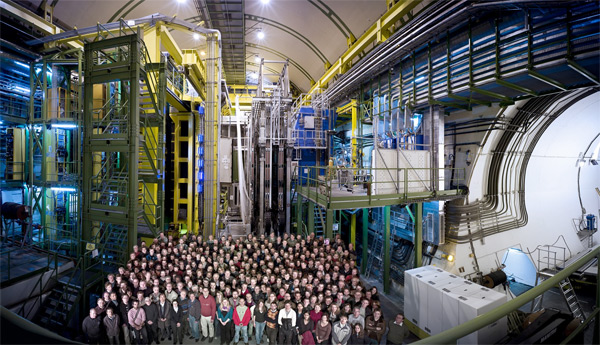
LHCb is an experiment set up to explore what happened after the Big Bang that allowed matter to survive and build the Universe we inhabit today
Fourteen billion years ago, the Universe began with a bang. Crammed within an infinitely small space, energy coalesced to form equal quantities of matter and antimatter. But as the Universe cooled and expanded, its composition changed. Just one second after the Big Bang, antimatter had all but disappeared, leaving matter to form everything that we see around us — from the stars and galaxies, to the Earth and all life that it supports.
-
Evidence for the decay B0→μ+μ– and improved measurements of Bs0→μ+μ–
Today, the LHCb collaboration submitted for publication a paper reporting the first single-experiment evidence for the B0→μ+μ– decay with 3σ significance using a data sample recorded with the LHCb Upgrade I detector during LHC Run 3. The evidence grows to 3.2σ after combination with the Run1 and Run 2 data. The world’s most precise measurements…
-
Run 3: Sitting on a Goldmine
At the end of June 2026, LHCb recorded data from the last proton-proton collisions of LHC Run 3. The collaboration has now had time to take stock of what has been an extraordinary data harvest with the upgraded experiment. LHCb Upgrade I was installed in preparation for Run 3. It pioneered fully software-based event filtering,…
-
Discovery of a beauty-strange particle with unexpected properties
The LHCb collaboration has just reported the observation of a resonance in the Bs0π0 invariant-mass spectrum with a global significance exceeding seven standard deviations at the 43rd International Conference on High Energy Physics at Natal, Brazil, ICHEP 2026. The new particle, Bs0*(5700)0, exhibits a substantial mass deficit and a narrow natural width compared to the…
-
Precision measurement of the B0 and B+ lifetimes
The LHCb collaboration has just reported the measurement of the effective lifetime of the B0 meson in the decay B0→J/ψK*(892)0 and B+ meson lifetime in the decay B+→J/ψK+ at the 43rd International Conference on High Energy Physics at Natal, Brazil, ICHEP 2026. The image above shows the B0 invariant mass spectrum on the left with…
-
Timothy Gershon and Paula Collins – new spokesperson team for the LHCb Collaboration
On 1 July 2026, the management of the LHCb collaboration is changing. The new spokesperson team of Tim Gershon (Spokesperson, University of Warwick) and Paula Collins (Deputy Spokesperson, CERN) will take over from Vincenzo Vagnoni (INFN Bologna), Patrick Robbe (IJCLab) and Ulrich Uwer (Heidelberg University). Tim and Paula will work together in the LHCb management…