

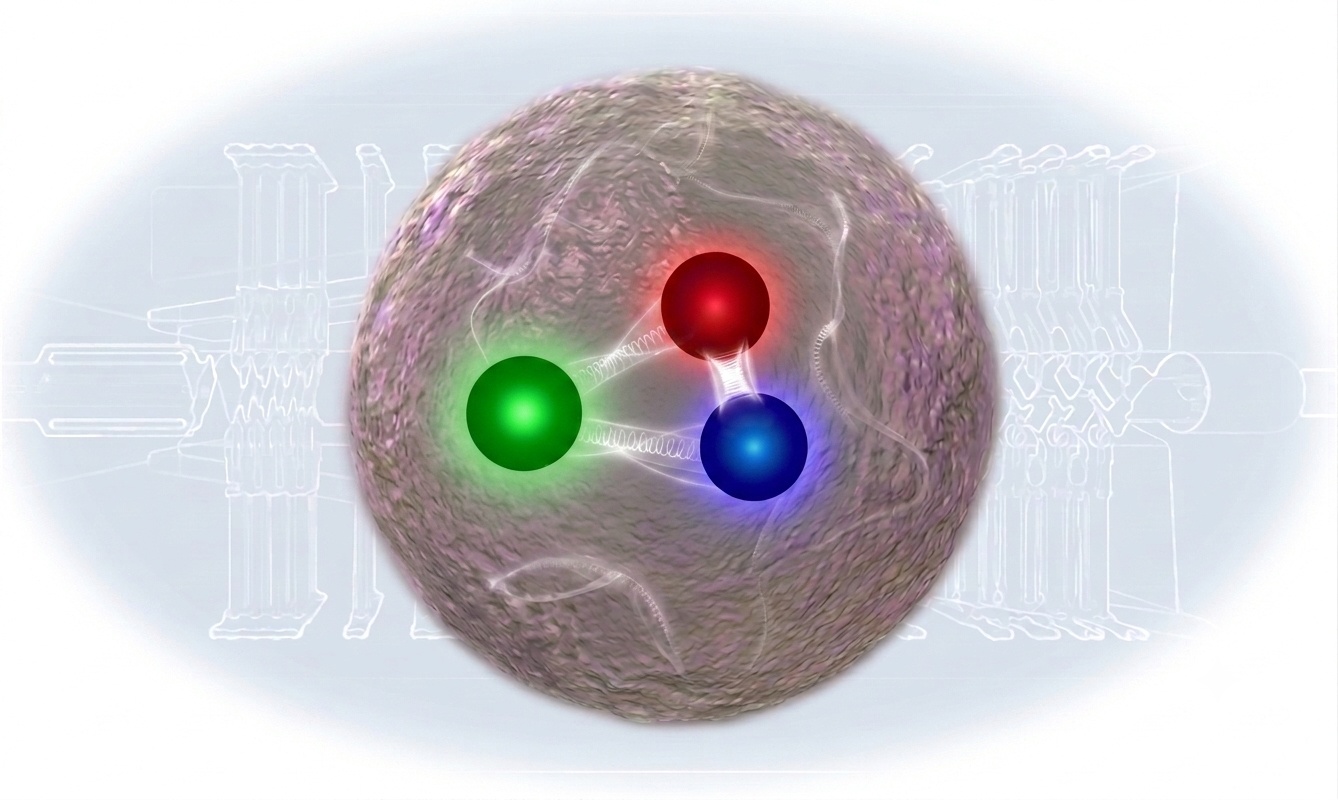
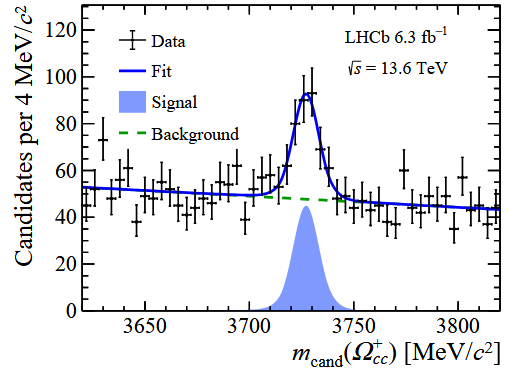
In a major new discovery, LHCb has announced the observation of the doubly charmed Ωcc+ baryon at the Beauty 2026 conference in Maastricht. With this result, the experiment completes the family of doubly charmed baryons and adds a new chapter to a story that stretches back more than sixty years. The Ωcc+ was observed as a peaking structure in the Ωc0π+ mass spectrum, as seen in the image on the right. An artist’s impression of the new particle, which contains two charm and one strange quark, is shown in the image on the left.
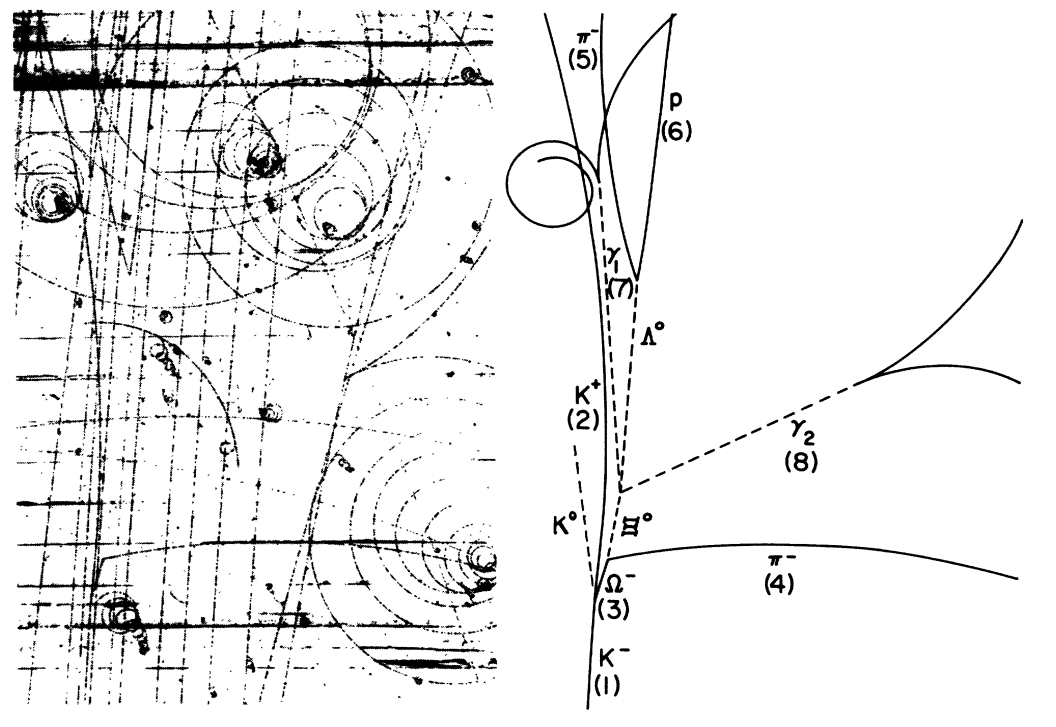
In the 1950’s many new subatomic particles were being discovered, but there was no clear way to classify them. At a CERN conference in 1962 two theorists, Murray Gell-Mann and Yuval Ne’eman, independently proposed the “Eightfold Way” classification scheme, a kind of periodic table organising mesons and lighter bayons into symmetric families. One consequence of this scheme was the prediction that a new particle — christened Ω– — containing three strange quarks must exist. The new classification scheme enabled many properties of the new particle to be predicted, including its mass. This particle was discovered two years later through a single bubble-chamber photograph (shown in the image) obtained at the Brookhaven laboratory. This was a sensational confirmation of the theory, which was extended in the 1970s to include charm quarks. The doubly charmed baryon Ωcc+ is analogous to the Ω–, but contains two charm (c) quarks in place of two strange quarks. It has never previously been experimentally observed despite being predicted to exist for over 50 years.
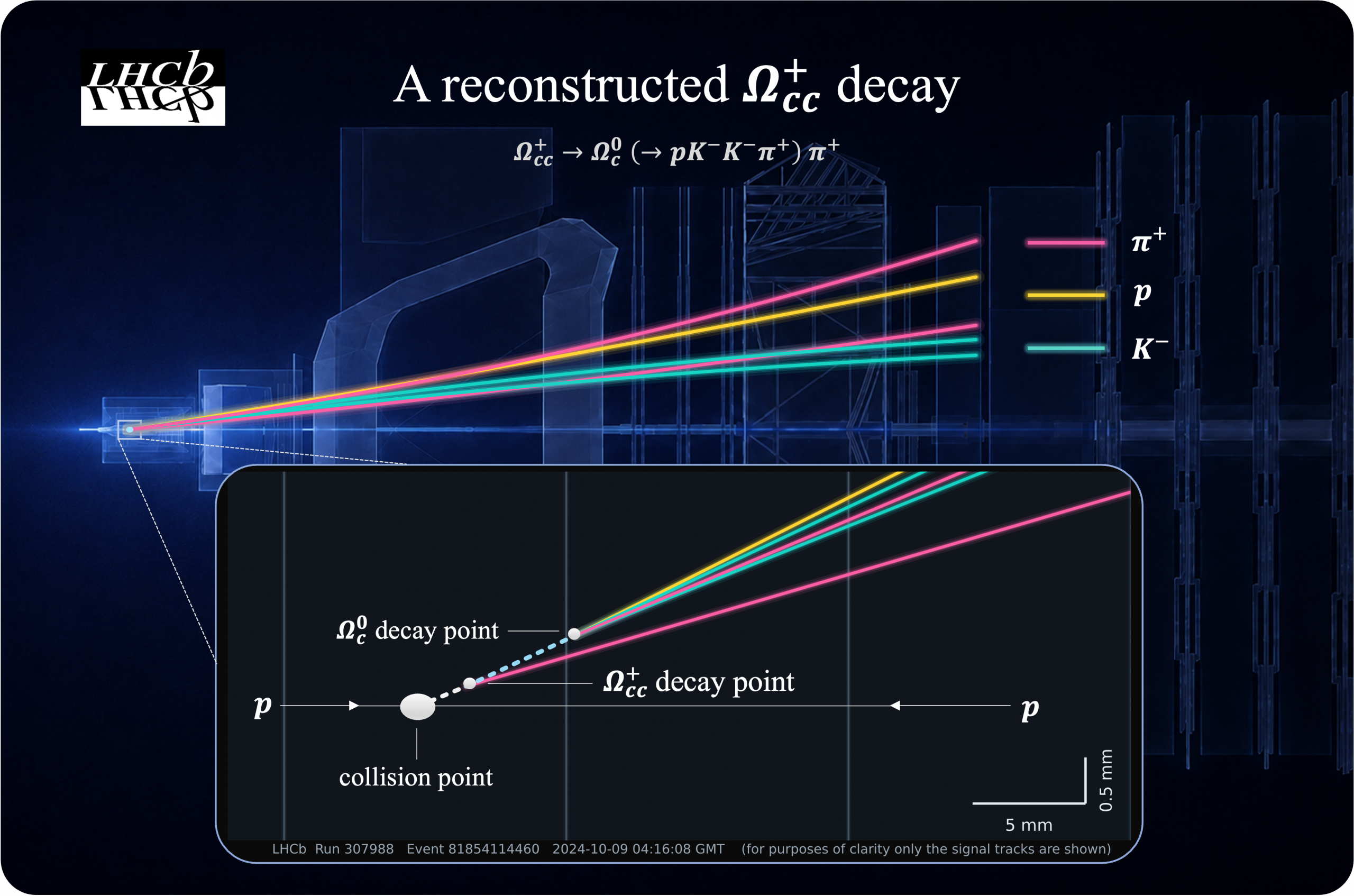
The Ωcc+ observation is based on data collected in 2024 with the upgraded LHCb detector. The Ωc is identified through its decay into a proton, two kaons and a pion, producing a total of five charged tracks in the detector. By tracing these tracks back to their points of origin, the analysis reveals the characteristic signature of a short-lived particle travelling a small but measurable distance before decaying, and with a mass peak at the expected value around 3727 MeV/c2. The event display shown below, the modern analogue of the bubble chamber picture, shows this cascade of distinct decay vertices emerging from the proton-proton collision point. While the original Ω⁻ was discovered by scanning 80,000 bubble-chamber photographs, the Ωcc+ required the full power of the upgraded LHCb detector, selecting rare signals from trillions of proton-proton collisions.
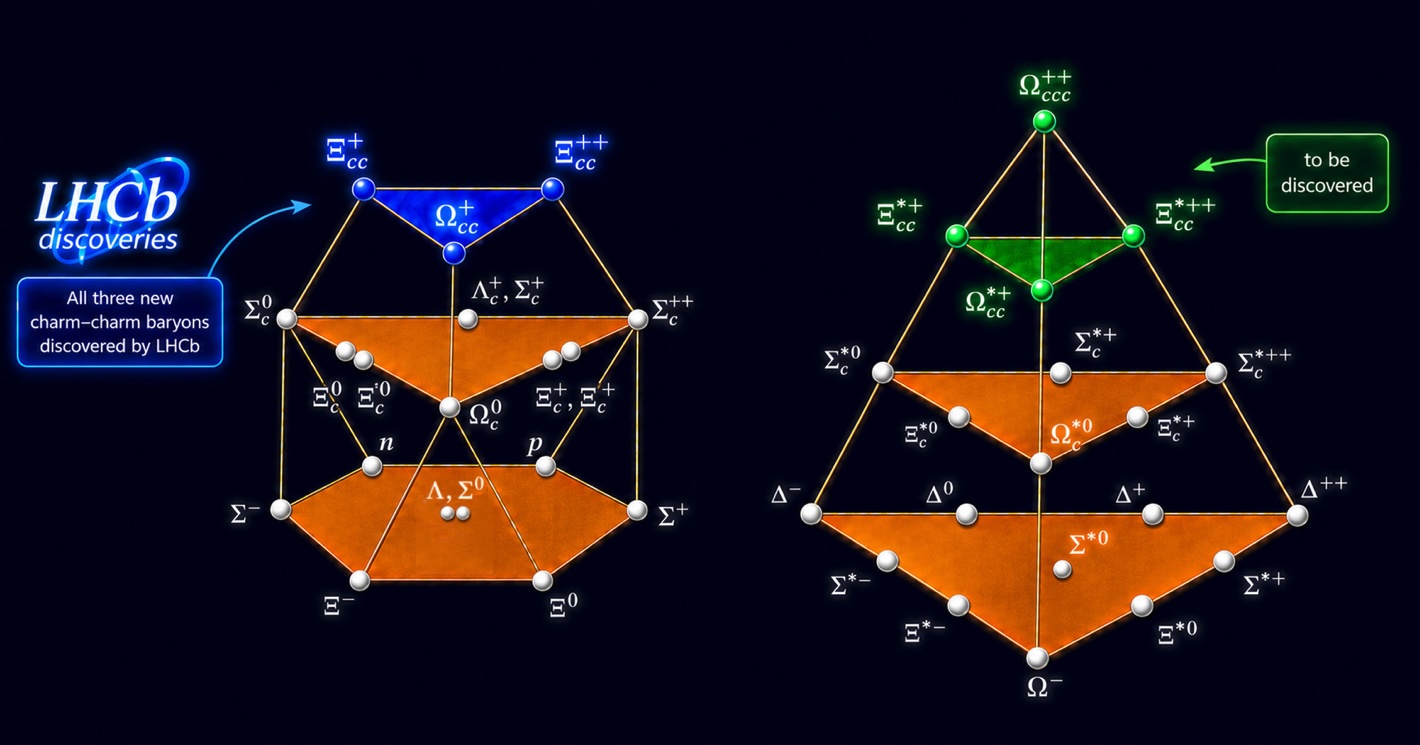
The image on the right displays Gell-Mann’s original geometric patterns forming the base levels of larger, multi-dimensional multiplets that incorporate charm quarks. The trio of doubly charmed baryons shown as the top “blue” level of the left image have all been discovered by LHCb: the Ξcc⁺⁺ baryon in 2017 and the Ξcc⁺ baryon earlier this year. The expanded multiplet of ground state spin-1/2 baryons is now complete. While this is a major milestone, the story is not yet over, as several spin-3/2 states have yet to be observed, along with additional baryons containing beauty quarks, either in place of or in addition to charm quarks. Many of these particles are expected to come within reach of the LHCb Upgrade II.
Additional information can be found in the LHCb presentation and in the LHCb paper.