

The LHCb collaboration has just reported the measurement of the effective lifetime of the B0 meson in the decay B0→J/ψK*(892)0 and B+ meson lifetime in the decay B+→J/ψK+ at the 43rd International Conference on High Energy Physics at Natal, Brazil, ICHEP 2026.
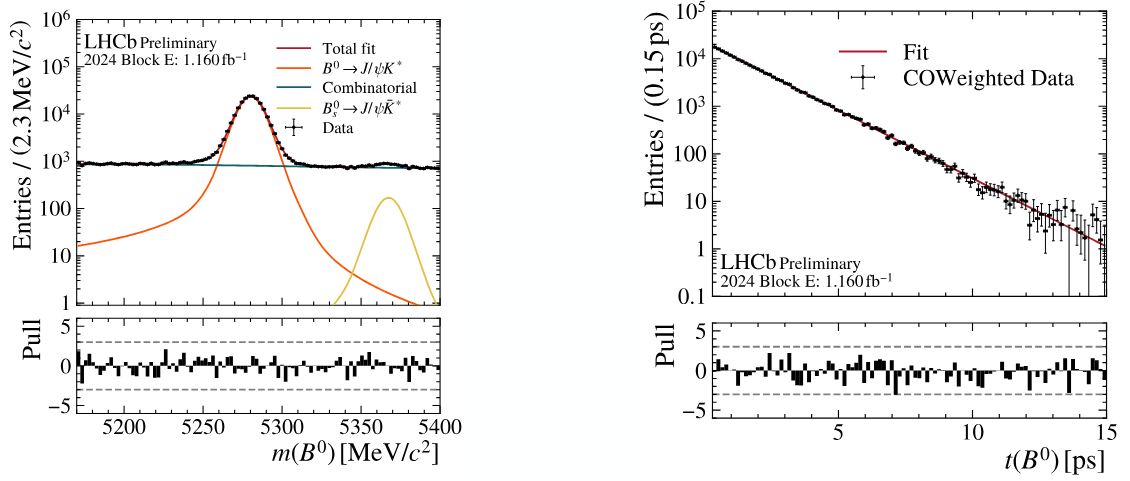
The image above shows the B0 invariant mass spectrum on the left with a log scale on the y-axis. The decay time distribution on the right allows to determine the effective lifetime to be τ(B0) = 1.5145±0.0020±0.0010 ps. This is the most precise measurement to date in this channel. In the decay time distribution the background has been subtracted by weighting the data.
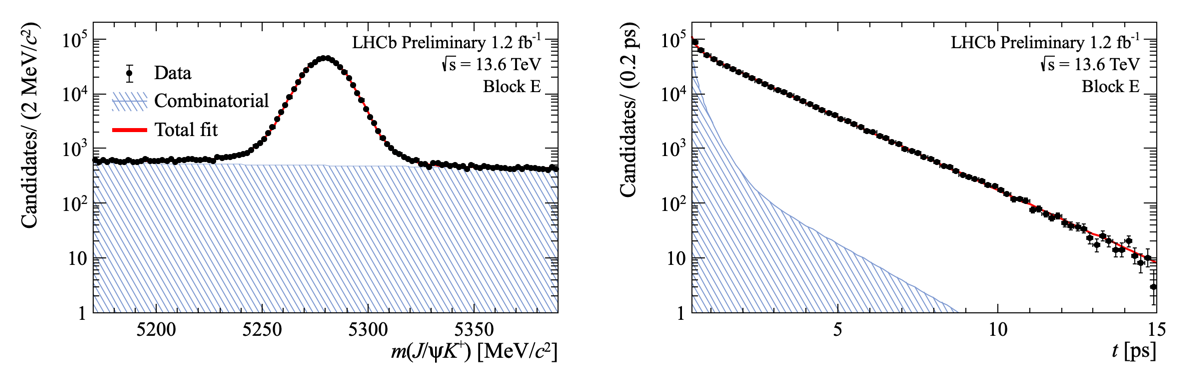
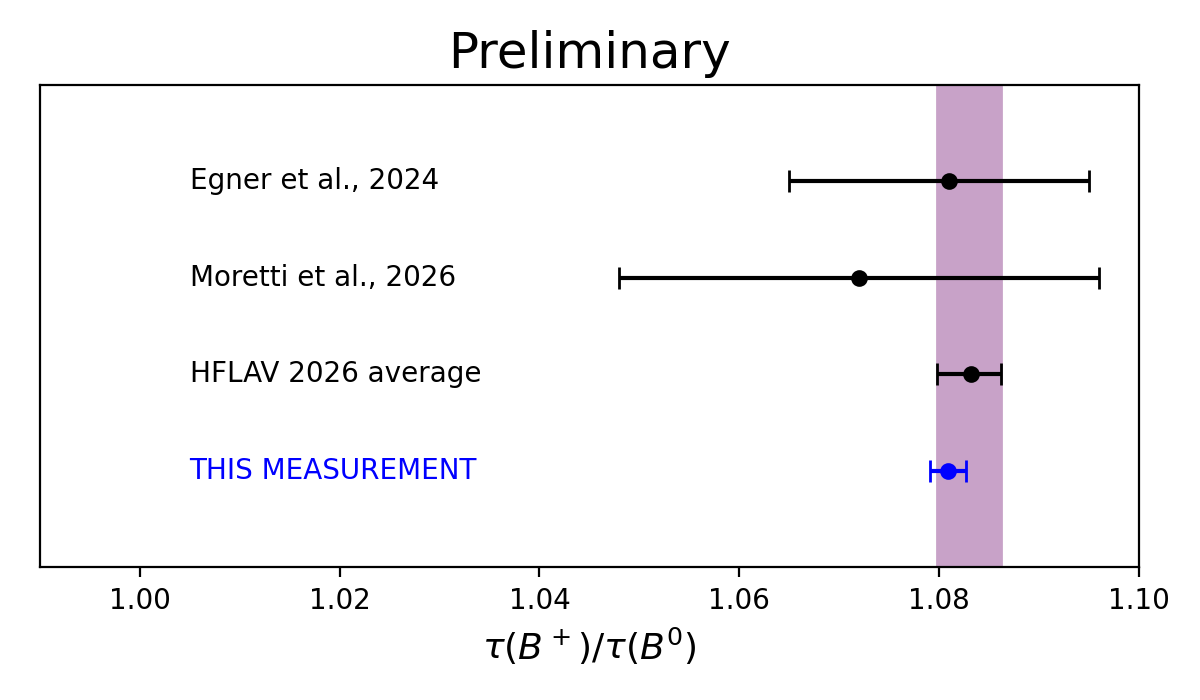
The invariant mass spectrum of the B+ meson is shown on the left image above with a log scale on the y-axis and its decay time distribution on the right with the background component shown explicitly. The measured lifetime is τ(B+) = 1.6370±0.0014±0.0014 ps. The ratio of the two lifetimes is measured to be τ(B+)/τ(B0) = 1.0809±0.0017±0.0007. The image on the left shows comparison of this value with the most recent theory predictions. The theory predictions are more precise for the lifetime ratios than for the individual measurements. The HFLAV/PDG average 1.0832±0.0034 is also shown.
Both lifetime values agree with the world average determined by HFLAV and with previous LHCb measurements. The B+ and B0 lifetimes are measured with improved precision, by a factor of three or more than a factor of three, respectively. They provide a stringent test of the Heavy Quark Expansion and the Standard Model in general. The analysis used 2024 dataset and profited from the excellent performance of the LHCb upgraded detector.
Additional information and further discussion can be found in the LHCb ICHEP presentation and in the forthcoming papers.