
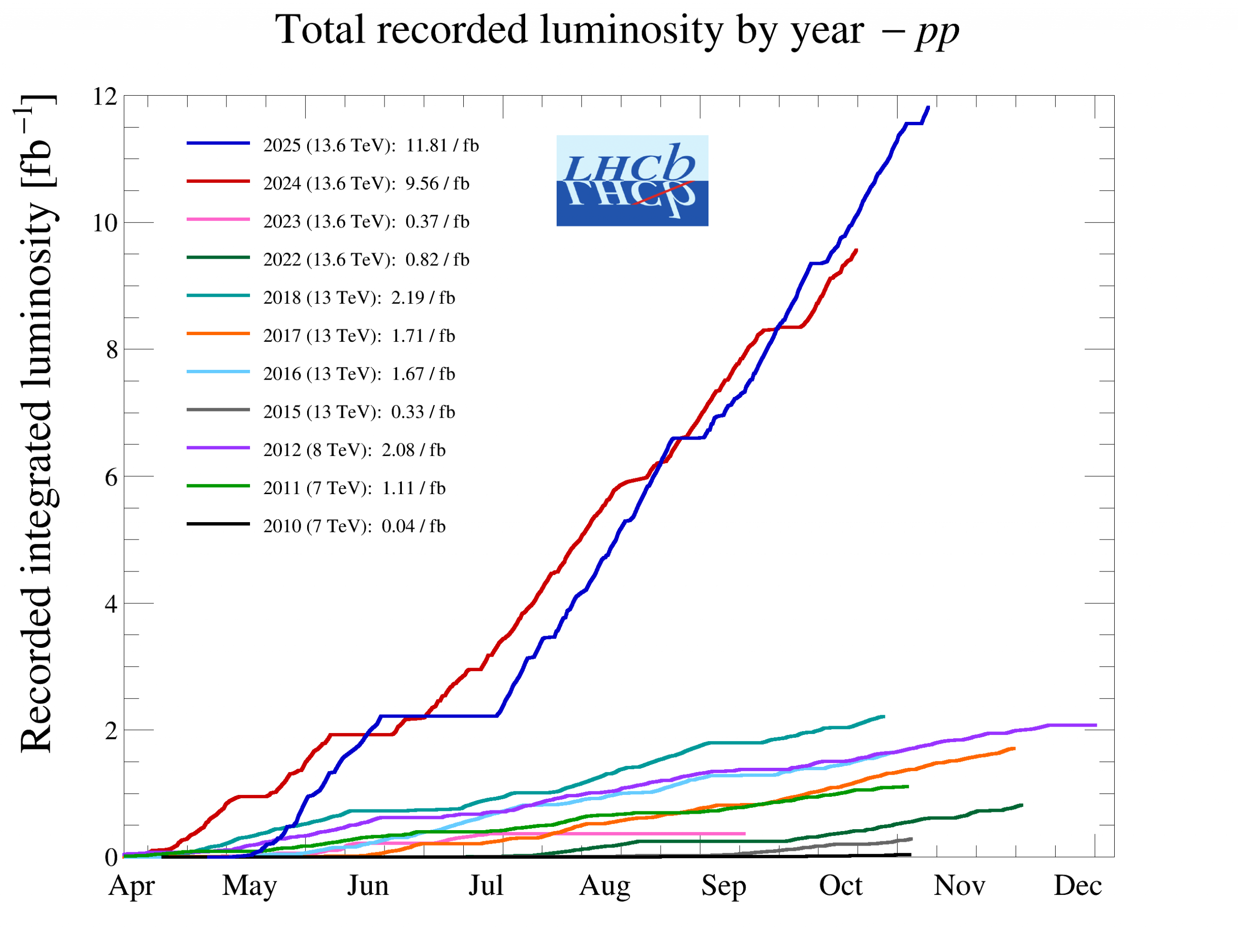
The proton–proton (pp) data-taking period for 2025 has just come to an end. Thanks to the commitment and expertise of members of the LHCb collaboration, the outstanding performance achieved throughout the entire pp run has been made possible. LHCb has successfully collected 11.8 fb-1 of high-quality pp data.
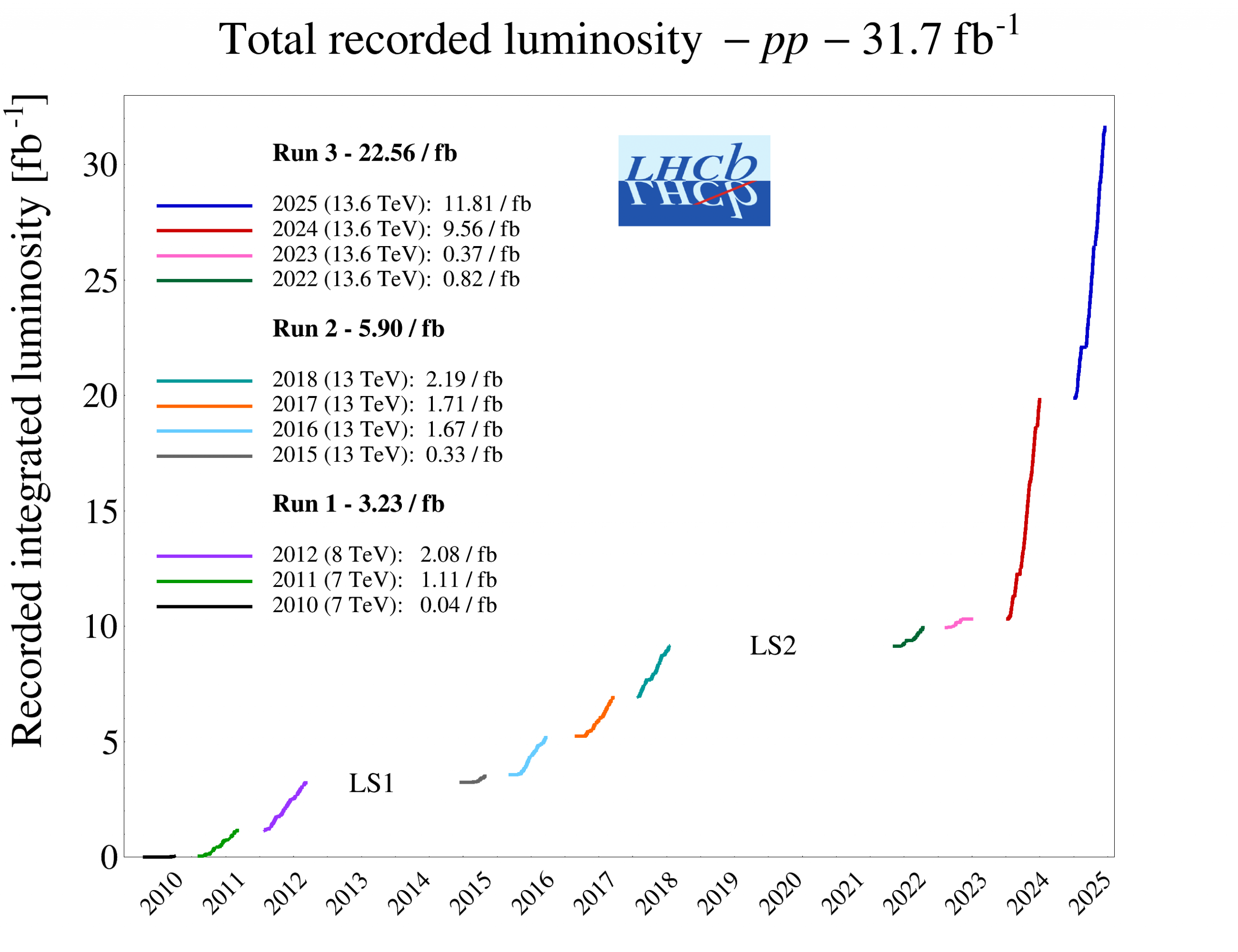
The image on the left below shows the accumulation of recorded pp luminosity during different pp data-taking periods. The highest ever recorded luminosity was obtained this year. The image on the right shows the total recorded luminosity accumulated since 2010. The increase in the data collection rate following the completion of the LHCb Upgrade 1 is clearly visible.
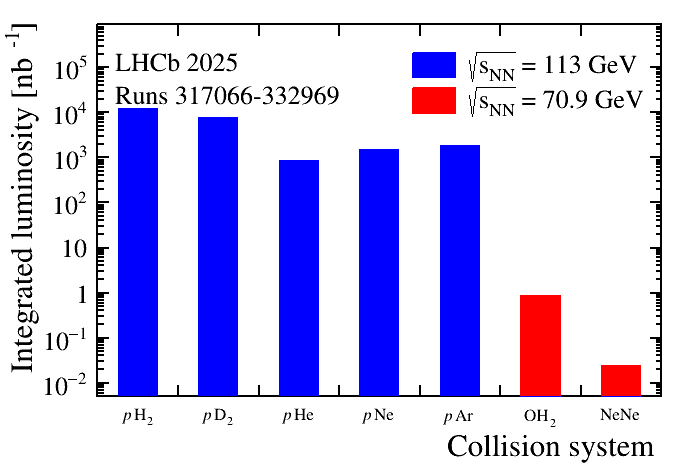
At the same time, the collaboration completed the full fixed-target programme. LHCb is unique in its ability to inject gases into the LHC beam pipe using the SMOG2 system. This allows collisions between particles from the two LHC beams, which circulate in opposite directions, to be recorded, as well as collisions between particles from one of the beams and the injected gas. Such collisions are known as fixed-target collisions.
The LHC carried out a special program involving light ions early in the summer. During these runs, LHCb successfully acquired proton-oxygen (pO) collisions, followed by oxygen-oxygen (OO) and neon-neon (NeNe) collisions. OH2 and NeNe collisions were also acquired in fixed-target mode. The plot shows the integrated luminosities collected so far for the entire fixed-target programme. This includes both the gas-injection period with circulating proton beams (pH₂, pD₂, pHe, pNe and pAr collision systems) and the period with circulating Oxygen and Neon ion beams (OH₂ and NeNe collision systems).
The dedication and teamwork of LHCb collaboration have made this campaign a true success, setting a strong foundation for the physics programme and the next operational period ahead. We are looking forward to finishing this year’s data taking with the heavy-ion run.