

Today at the Rencontres de Moriond Electroweak meeting, the upgraded LHCb experiment at CERN announced its first particle discovery: a new kind of heavy proton-like particle known as the Ξcc⁺.
To appreciate what makes this particle special, it helps to recall how an ordinary proton is built. A proton contains three quarks – two up quarks and one down quark (uud). Up and down quarks are so light that most of the proton’s mass comes not from the quarks themselves but from the swirling energy of quarks and gluons inside it. Thanks to Einstein’s famous equation, E = mc², that internal energy contributes directly to the proton’s mass.
The newly observed Ξcc⁺ is like a proton that has undergone a dramatic “quark upgrade”. In place of its two up quarks, it carries two heavy charm quarks, giving it a quark composition of ccd. Charm quarks are the heavy relatives of up quarks – they have same charge and properties but a larger mass and come from the next generation in the Standard Model. Because charm quarks are far heavier than up quarks, the Ξcc⁺ weighs roughly four times more than an ordinary proton.
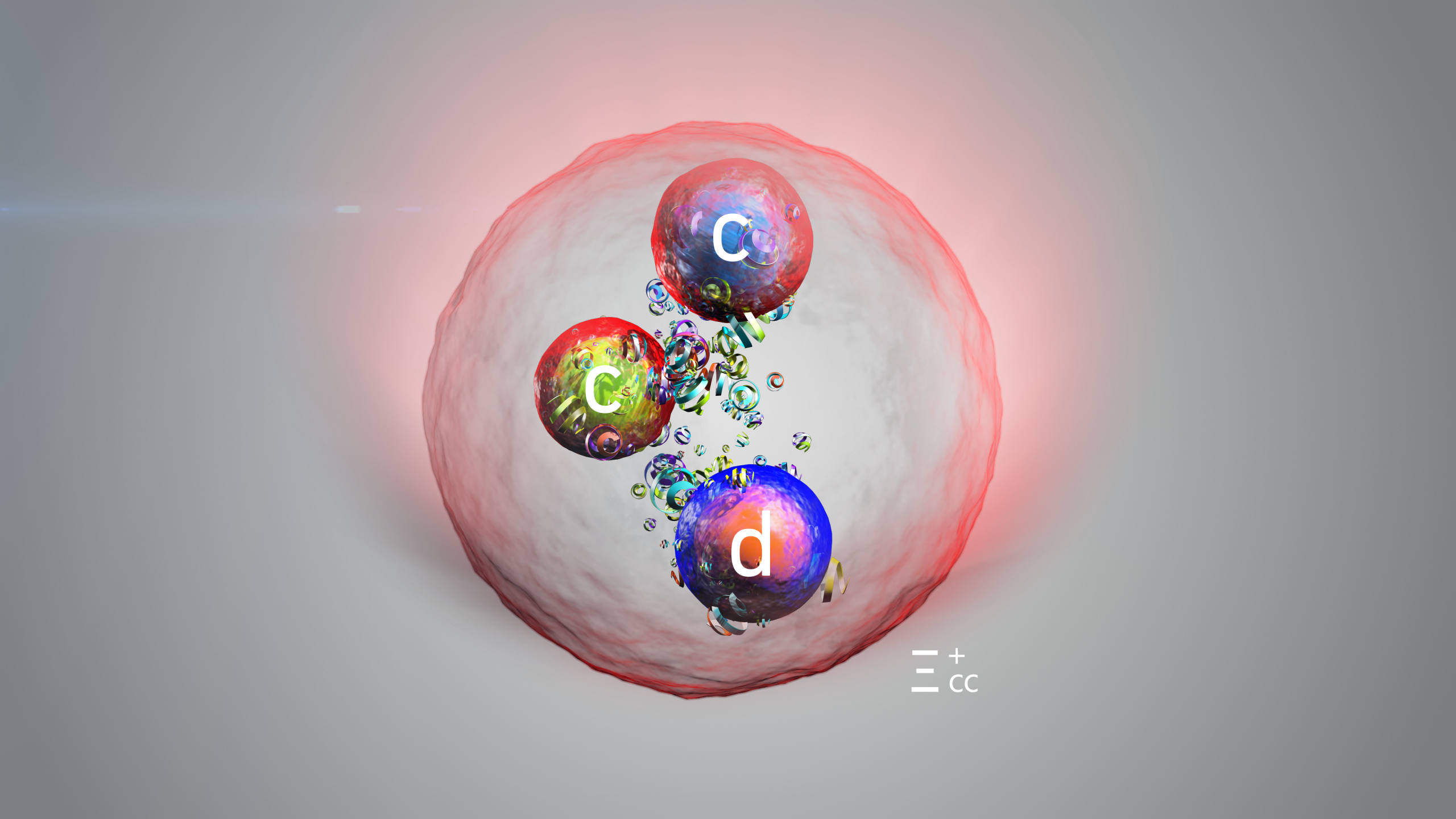
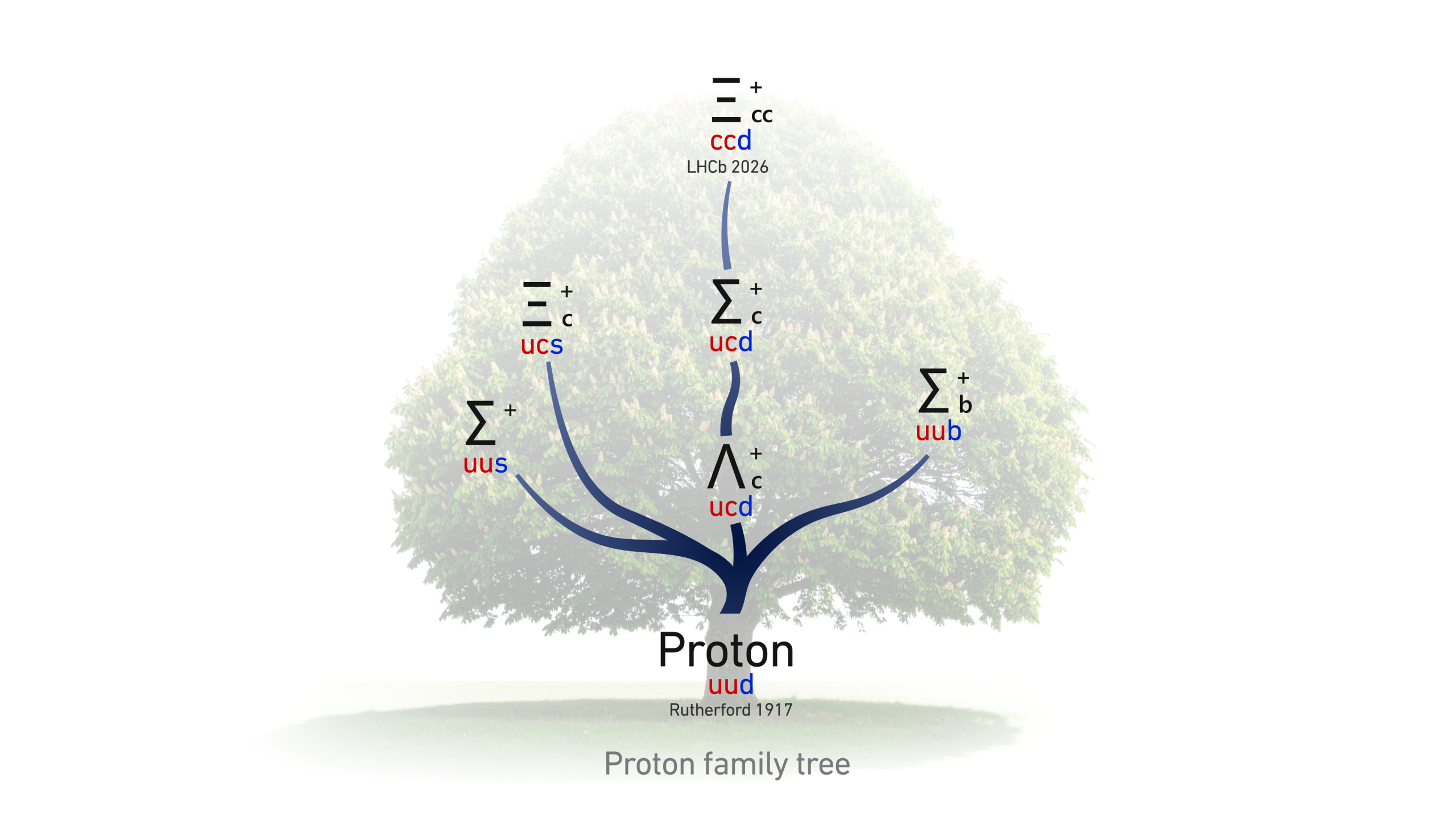
The image above left shows an artist’s illustration of this exotic particle, while a “proton family tree” on the right traced how heavier relatives are formed by replacing the proton’s quarks with strange (s), charm (c), or bottom (b) quarks. In this picture, the Ξcc⁺ sits near the very top—where both of the proton’s light up quarks have been swapped for charm.
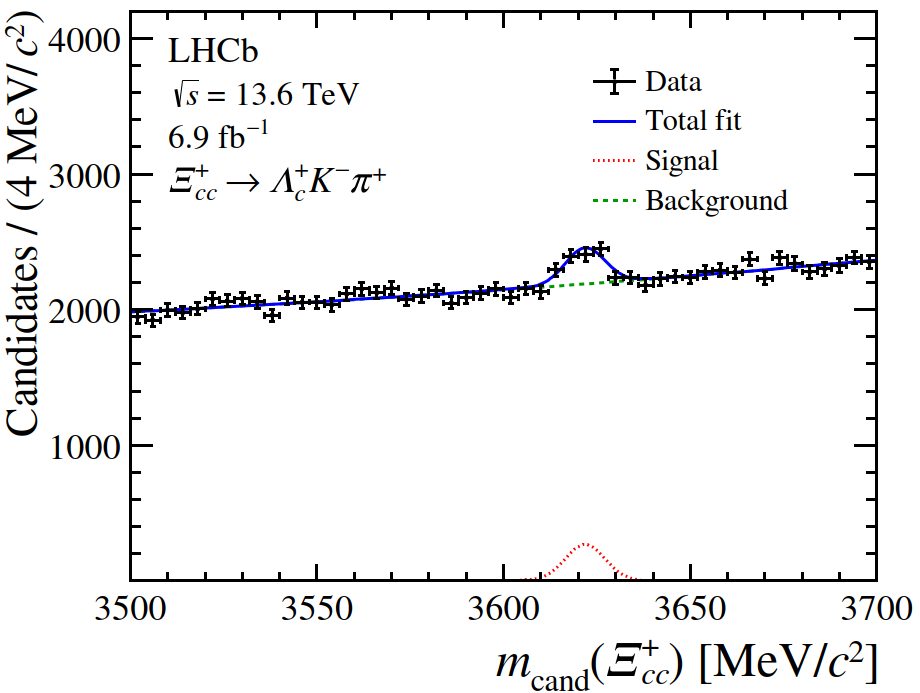
The discovery is based on proton-proton collision data collected in 2024 during LHC Run 3 and marks the first new particle identified with the upgraded LHCb detector. The Ξcc⁺ was spotted through its decay into three lighter particles:
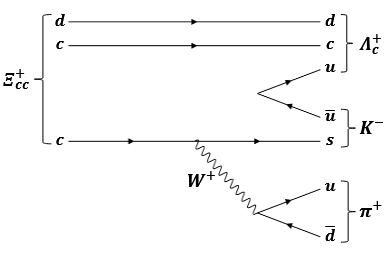
Ξcc⁺ → Λc⁺ K⁻ π⁺ – as shown in the Feynman diagram,
with the Λc⁺ itself decaying via p K⁻ π⁺.
By reconstructing the combined (“invariant”) mass of these decay products shown above, researchers observed a clear peak of about 915 events around 3620 MeV/c² – a signal exceeding 7 σ, well above the threshold required to claim a discovery. A detailed fit measured the mass to be:
3619.97 ± 0.83 ± 0.26 (+1.90 / −1.30) MeV/c².
This particle is the isospin partner of the Ξcc⁺⁺ (ccu), discovered by LHCb in 2017. Because the up and down quarks behave almost identically, theory predicts that the Ξcc⁺ and Ξcc⁺⁺ should have nearly the same mass. Until now, however, observing the Ξcc⁺ proved extremely challenging. A result from the SELEX experiment more than 20 years ago suggested a much lighter particle, but subsequent searches by FOCUS, BaBar, Belle, and earlier LHCb datasets found no confirmation of this claim.
Thanks to the enhanced performance of the upgraded LHCb detector, the Ξcc⁺ has now been observed at a mass consistent with its Ξcc⁺⁺ partner – compatible with where theory expected it to be after LHCb’s previous discovery.
Full details can be found in the LHCb Moriond presentation, in the forthcoming accompanying scientific paper and in the CERN media update in English and French.