


Today, at the CERN seminar, the LHCb Collaboration presented a new test of lepton flavour universality (LFU), one of the basic principles of the Standard Model (SM) of particle physics. This principle states that the SM treats the three charged leptons (e, μ and τ) identically, except for kinematical effects due to their different masses. In this analysis LHCb physicists compared the Bc+ mesons decaying into a J/ψ meson together with a τ or μ lepton and their corresponding neutrino. The measured observable is the ratio of branching fractions R(J/ψ) = ß(Bc+→J/ψτ+ντ) / ß(Bc+→J/ψμ+νμ). This ratio is particularly interesting since a large class of SM extensions contain new interactions that involve the third generation of quarks and leptons, such as here a b quark (from a Bc+ meson) and τ– and ντ leptons. The Feynman diagrams show the SM contribution together with possible contributions from new physics processes.
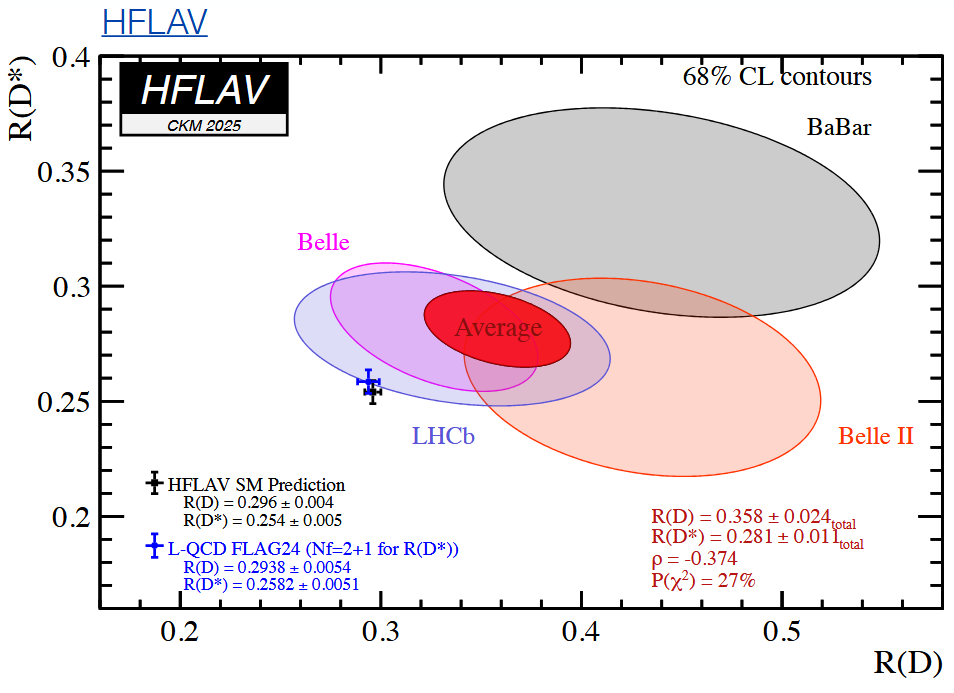
Other measurements of the similar ratios R(D) and R(D*), defined as ß(B→Dτ–ντ)/ß(B→Dμ–νμ) and ß(B→D*τ–ντ)/ß(B→D*μ–νμ) respectively, show an excess of semitauonic decays, currently at about 3.8 standard deviations above the predictions which assume LFU, representing a persistent tension with the SM as shown at the left image below.
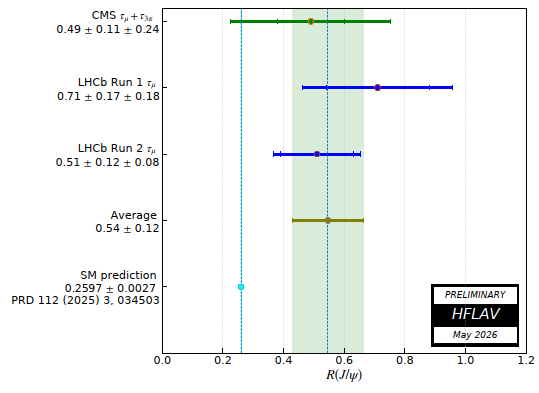
LHCb physicists used the proton-proton (pp) collision data taken by the LHCb detector during 2016–2018 (LHC Run 2) at a center-of-mass energy of 13 TeV, corresponding to an integrated luminosity of 5.6 fb−1, which represents a factor of four increase in the b-hadron sample size relative to the previous LHCb measurement, based on Run 1 data, owing to a nearly twofold increase in the b-hadron production cross section at the higher pp collision energy during Run 2. The measured preliminary value is found to be R(J/ψ) = 0.51±0.12(stat)±0.08(syst), which is within 1.8 standard deviations of the predictions from the Standard Model assuming LFU, R(J/ψ)=0.2597±0.0027. This result is shown in the right image above together with the result of the Run 1 measurement as well as with the CMS combined result. The HFLAV combination of the three results gives 0.54±0.12 which is 2.4 standard deviation above the SM prediction showing a similar trend as R(D)&R(D*) measurements.
Additional information can be found in the LHCb presentation.