

LHCb has just submitted for publication a paper reporting a measurement of the CKM angle γ using the decay channels B±→DK± and B±→Dπ±, where the D meson decays to D→KS0 π+π− or D→KS0K+K−. This is the first measurement of the CKM angle γ using data collected in 2024 with the upgraded LHCb detector.
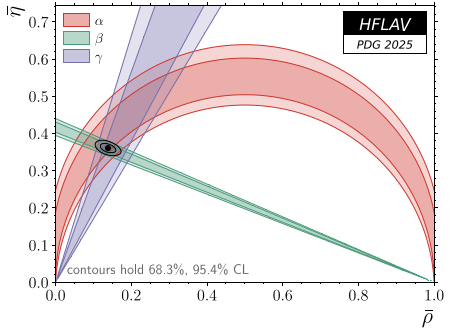
LHCb is an experiment designed to study the physics phenomenon called “CP violation”, that is strictly related to the disappearance of antimatter soon after the Big Bang allowing only matter to survive and build the universe we live in today. To do this, LHCb physicists measure differences between the properties of matter and antimatter particles, due to the presence of CP violation. CP violation was discovered experimentally in 1964 in the decay of neutral K mesons. In 1973, M. Kobayashi and T. Maskawa proposed a mechanism that could incorporate CP violation into the theory that is now known as the Standard Model of Particle Physics (SM), predicting the existence of at least 3 families of particles; they were awarded the 2008 Nobel Prize in Physics for this idea. The size of CP violation in the SM is set by the parameter η, shown as the y-axis in the figure at the left. Constraints on η and the related parameter ρ (the x-axis) are measured in various ways in different experiments as shown in the compilation made by the HFLAV group in the figure. The constraints show that in fact the values of ρ and η within the small coloured region in the centre of the figure are indeed compatible with the experimental results, thus confirming the Kobayashi and Maskawa SM mechanism of CP violation. However, as this mechanism does not explain the large amount of matter observed in the universe, physicists are looking for other sources of CP violation beyond the SM.
An important measurement in this context is checking whether the value of the angle γ of the unitary triangle is compatible with the intersection of all the other constraints. Any disagreement about where to place the apex of the unitarity triangle would be a sign of new physics. Measuring the angle γ in different processes is one of main goals of the LHCb experiment.
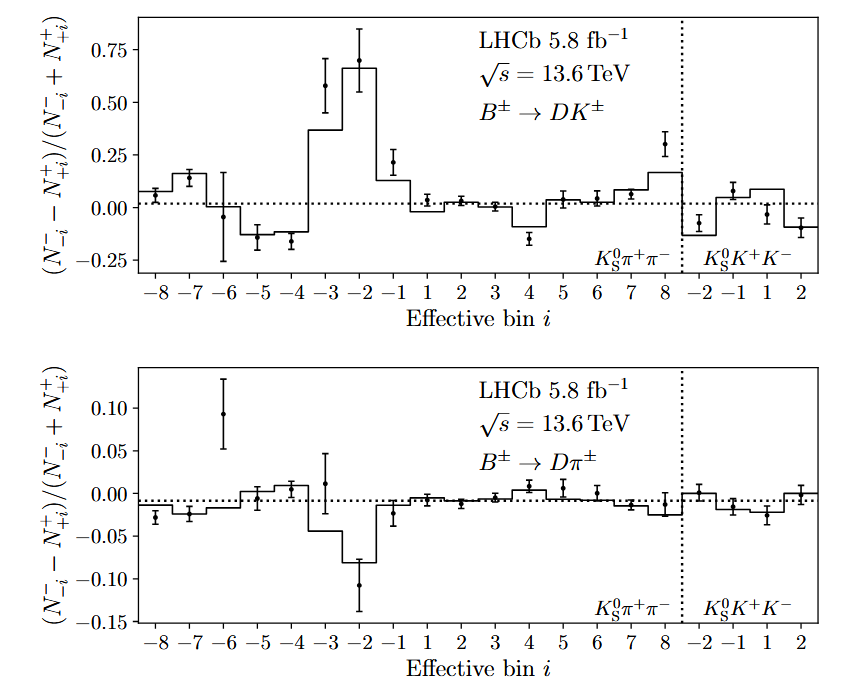
Analysis of B±→DK± and B±→Dπ± decays provides a powerful method to measure the angle γ. CP violation in this decay is observable through the difference in the distributions in phase space between B+ and B– decays. The plot shows the varying asymmetry in different regions of phase space, both for D decays to KS0 π+π− (left of the vertical dashed line) and D→KS0K+K− (right of the line). The solid lines show the results of a fit to the data with γ as a free parameter, which agree well with the data distributions.
The results are interpreted in terms of the angle γ and other related parameters. The value of γ obtained in this way is γ=(68.1±6.7)°. The analysis profitted from the large increase of of signal efficiency obtained with the upgrated LHCb detector – with just 4 month of Run 3 data, the total yield from Run 1+2 in this key decay was surpassed.
The LHCb collaboration has performed γ angle measurements in a wide ensemble of B and D decay modes. The recent result obtained by a simultaneous combination of measurements sensitive to the CP-violating angle γ, to the charm parameters describing oscillations (mixing) between D0 and D0 mesons and to the CP asymmetries in charm decays gives the value γ=(62.8±2.6)°. This combination result will be still improved when the results of the new measurement just submitted for publication will be included in the future combination.
Further information can be found in the LHCb submitted paper.