

The LHCb collaboration has just reported the observation of a resonance in the Bs0π0 invariant-mass spectrum with a global significance exceeding seven standard deviations at the 43rd International Conference on High Energy Physics at Natal, Brazil, ICHEP 2026. The new particle, Bs0*(5700)0, exhibits a substantial mass deficit and a narrow natural width compared to the conventional quark model predictions. Following these unexpected properties, it can be identified either as the long-sought chiral partner of the ground-state Bs0 meson or as the first exotic hadron containing a single bottom quark. Either scenario marks a pivotal advancement in QCD, offering a unique portal to fundamental symmetry or novel forms of hadronic matter.
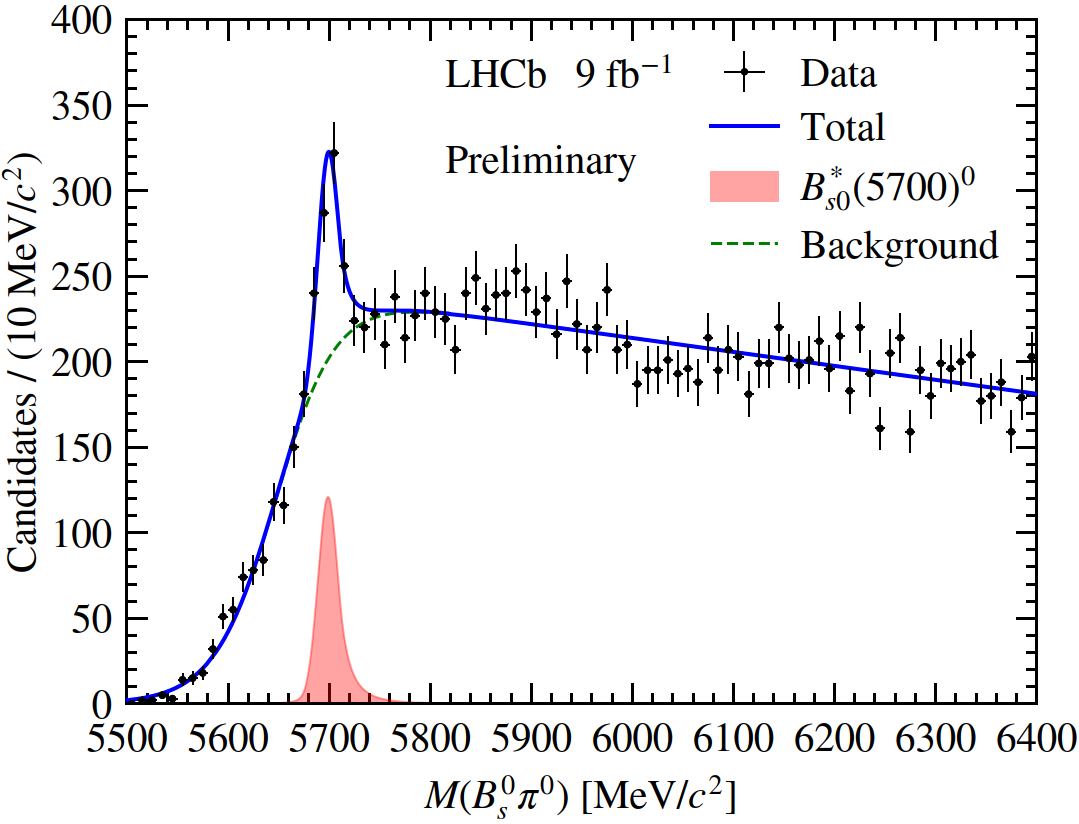
In the first stage of the analysis LHCb physicists reconstructed Bs0 mesons using three decay modes, Bs0→Ds–π+, Bs0→J/ψφ and Bs0→ Ds–π+π+π–. The selected Bs0 mesons are then combined with π0 mesons reconstructed from the π0→γγ decay, requiring the two photons to be identified as two separate clusters in the electromagnetic calorimeter. A peaking structure is consistently observed across all three individual Bs0 decay modes at the mass 5698.9±1.5±0.6±0.1 MeV/c2 and with the width smaller than 9.8 (11.8) MeV at 90% (95%) confidence level. The Bs0π0 invariant-mass spectrum, summed over all three decay channels, is shown in the image above.
The vast majority of visible matter in the universe is composed of hadrons, which are bound states of quarks and gluons held together by the strong interaction, mathematically described by the theory of the strong interaction, Quantum Chromodynamics (QCD). At low energy, QCD exhibits two profound phenomena that shape the properties of the hadronic world: colour confinement, which bounds quarks and gluons into colour-neutral hadrons, and the spontaneous breaking of chiral symmetry, which causes the light quarks to acquire substantial mass through their dynamics, thereby generating over 98% of the baryonic mass of the universe. At high energy, QCD exhibits asymptotic freedom, enabling precise perturbative calculations. However, as energy decreases, the growing strength of the strong force drives QCD into a non-perturbative domain where theoretical treatments become analytically difficult. Understanding the emergence of hadronic matter from these complex dynamics remains a key fundamental challenge in particle physics. Hadron spectroscopy provides critical insights into the non-perturbative landscape of QCD by mapping the energy levels and properties of hadronic states, which encode the fingerprints of both colour confinement and chiral symmetry breaking. It has acquired renewed momentum in recent decades with the observation of a rich spectrum of exotic hadrons, which challenge the traditional hadron classification scheme and provide crucial testbeds for QCD dynamics.
The BaBar collaboration discovered in 2003 the Ds0*(2317)+ meson having a substantial mass deficit and an exceptionally narrow width. The discovery triggered a flurry of theoretical activities. The Bs0*(5700)0 particle, whose discovery was announced today, is most naturally identified as long awaited lowest-lying scalar Bs0 meson, the beauty counterpart of Ds0*(2317)+. Taken together, the discovery of Bs0*(5700)0 establishes a consistent anomaly across both charm and beauty sectors. It signals a departure from the traditional constituent quark model and drives a paradigm shift in our understanding of QCD dynamics.
Additional information and further discussion of extraordinary properties of the new particle can be found in the LHCb ICHEP presentation and in the LHCb paper.