

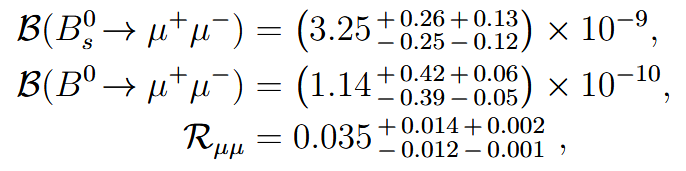
Today, the LHCb collaboration submitted for publication a paper reporting the first single-experiment evidence for the B0→μ+μ– decay with 3σ significance using a data sample recorded with the LHCb Upgrade I detector during LHC Run 3. The evidence grows to 3.2σ after combination with the Run1 and Run 2 data. The world’s most precise measurements of the Bs0→μ+μ– branching fraction and effective lifetime are also reported. The results was presented at the CERN seminar, which initiated the traditional workshop between the LHCb collaboration and the theory community, “Implication of LHCb measurements and future prospects”.
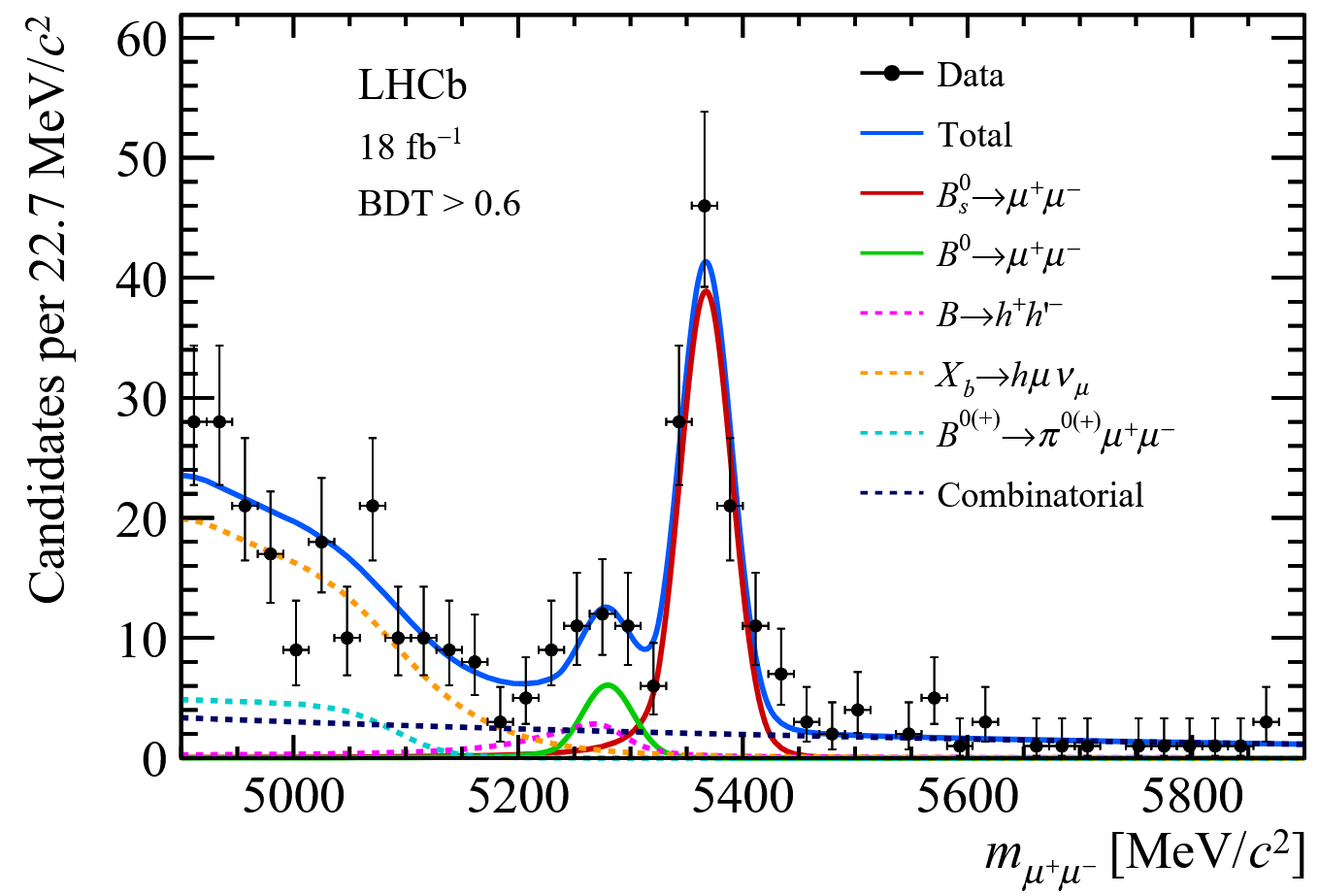
Data collected in 2024 and 2025 were used to obtain this result. The μ+μ– invariant mass spectrum is shown in the image above. The contribution of the Bs0→μ+μ– rare decay is clearly visible at the Bs0 mass and is indicated as the red peaking function. The green peaking function at lower mass shows the contribution from the even rarer B0→ μ+μ– decay, whose Standard Model (SM) rate is about 30 times smaller than that of the Bs0→ μ+μ– decay. However, the production of B0 is 4 times more abundant than that of Bs0 and therefore the ratio of yelds is about a factor of 7. The background distributions are also shown.
The probability, or branching fraction, of the Bs0 and B0 mesons to decay into two oppositely charged muons is very small in the SM and is precisely calculated. On the other hand, a large class of theories that extend the SM with new particles such as, for example, additional Higgs bosons, Z’ vector bosons or leptoquarks, allow significant modifications to this branching fraction. Therefore an observation of any significant deviation from the SM prediction would reveal the influence of new physics. The decay of a Bs0 meson into a muon pair has long been regarded as one of the most promising places to search for these new effects. The search for this decay lasted more than 30 years, and was pursued by different experiments at different accelerators. Finally, the LHCb collaboration obtained the first evidence, with a significance of 3.5σ, in November 2012 and, together with the CMS collaboration, the first observation, with a significance of 6.2σ, in May 2015. Moreover, in February 2017, LHCb announced the first single-experiment observation, with a statistical significance of 7.8σ.
The joint LHCb/CMS analysis also reported evidence for the B0→μ+μ– decay, however, this was not confirmed in later analyses. The central value of the branching fraction makes this decay the rarest B decay yet measured, so today’s first single-experiment evidence announcement marks therefore an important milestone in history of particle physics.
Previous results already severely constrained the type of SM-extension models that are still allowed. The results announced today, in agreement with the SM, isolate even more precisely the parameter region in which these new models can exist, and therefore focuses future experimental searches and theoretical attention.
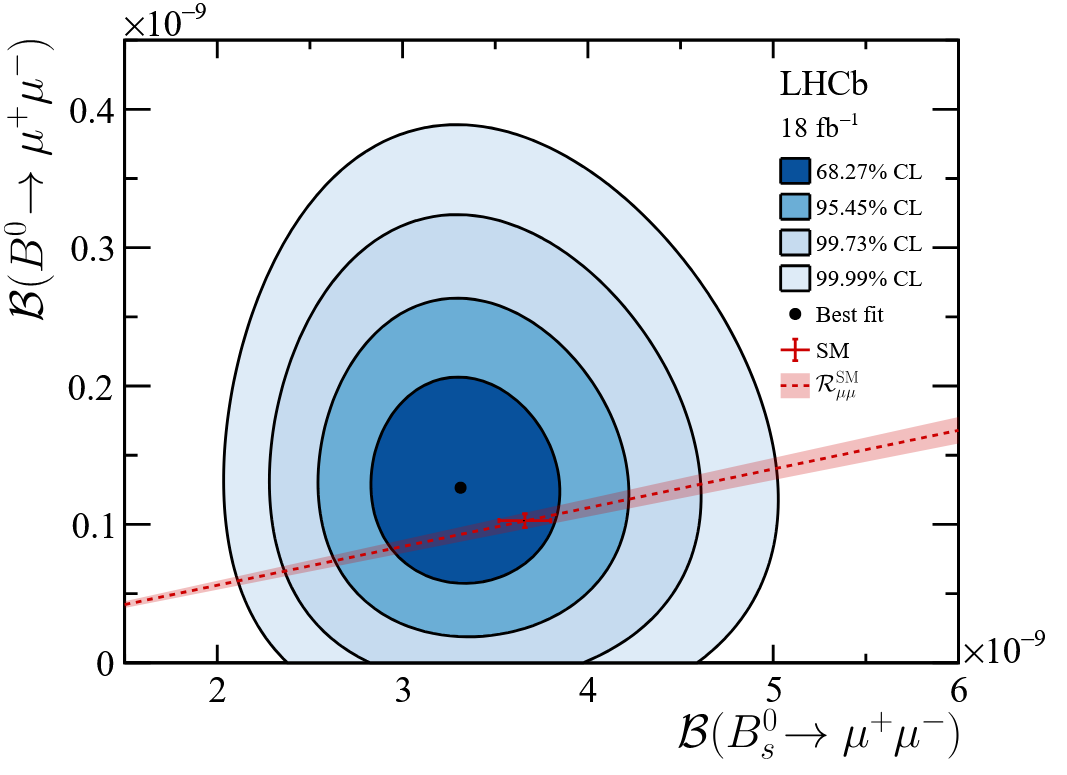
The numerical values obtained by the combination of Run 1+2+3 data sets are shown at the top of this news. The image above left shows the uncertainties on the Bs0 and B0→ μ+μ– brancbing fractions as a two-dimensional profile. The SM expectation is inside the 68.27% confidence levels region and thus compatible with the experimental data. The best experimental value is indicated by the black dot, the SM predictions are shown as a red cross, while allowed values in beyond SM theories that preserve the value of ℜμμ are shown as the red band. Contours with different confidence levels are overlaid.
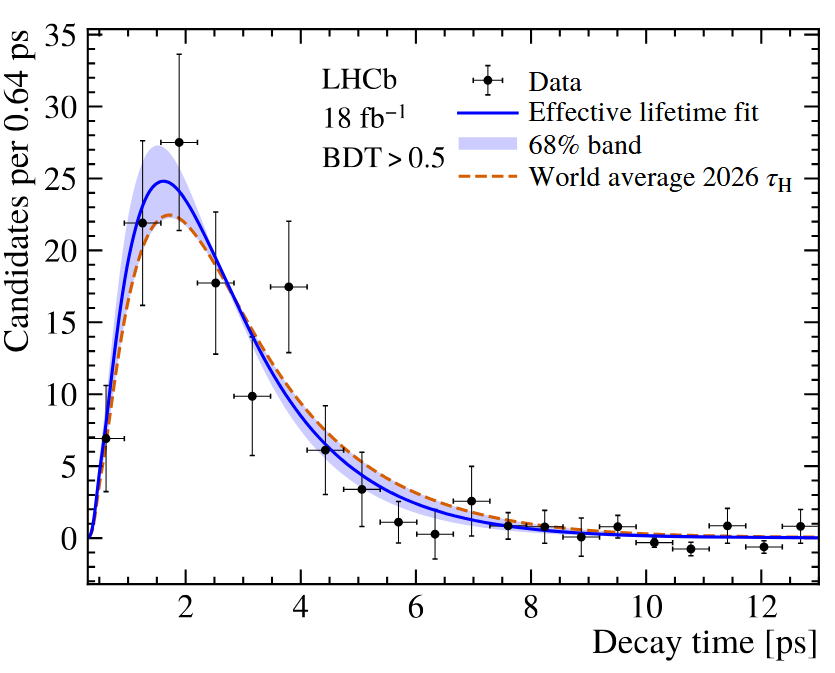
The ratio of B0/Bs0 branching fractions, ℜμμ, probes beyond SM models in a different way to the Bs0 branching fraction alone. Some new-physics models also allow the possibility of a different Bs0 “effective” lifetime from what is predicted in the SM. What is especially interesting is that some beyond SM models leave the branching fractions unchanged but alter the decay-time-dependent observables. LHCb also reported today an improved measurement of the Bs0 effective lifetime and found it to be 1.60±0.16±0.01 ps, in agreement with the SM prediction, using combination of Run 1, 2 and 3 data sets. The figure above right shows the distribution of the Bs0→μ+μ– decay time, along with the fit function used to measure the lifetime. The dashed red distribution corresponds to the SM value of the effective lifetime. The agreement of data with the SM prediction is clearly visible.
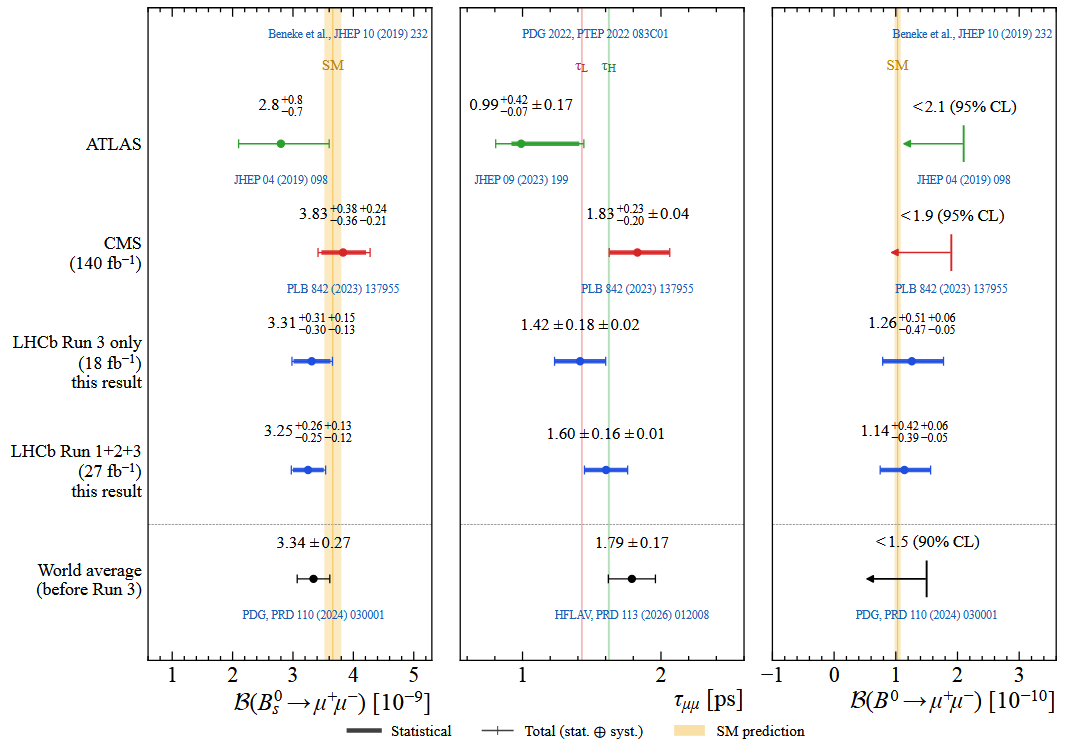
The image above shows comparisons of current best results from ATLAS, CMS and the new LHCb measurements.
In the middle of the next decade, a further upgrade of LHCb could increase the rate of data collection by another order of magnitude, turning these decays into precision probes with even greater sensitivity to undiscovered particles, giving physicists new opportunities to find cracks in the Standard Model and reveal what may lie beyond.
Additional information and further discussion can be found in the LHCb seminar presentation, in the LHCb paper and in the CERN media update.