
At the end of June 2026, LHCb recorded data from the last proton-proton collisions of LHC Run 3. The collaboration has now had time to take stock of what has been an extraordinary data harvest with the upgraded experiment.
LHCb Upgrade I was installed in preparation for Run 3. It pioneered fully software-based event filtering, capable of reconstructing LHCb data at 30 MHz and handling rates of around 24 Tb/s – which in 2022 represented more than 2% of global internet bandwidth. LHCb also pioneered the use of complex multivariate classifiers and machine learning algorithms in the real-time trigger, together with on-the-fly alignment and calibration, allowing physics-quality data to be written out directly.
The upgraded LHCb tracking system comprises a silicon-pixel vertex detector (VELO) surrounding the proton-proton interaction region, a silicon-strip detector (UT) positioned upstream of the dipole magnet, and a scintillating-fibre tracker (SciFi) downstream of the magnet, enabling precise reconstruction of charged-particle trajectories and momenta. LHCb has a unique capability to distinguish between pions, kaons and protons over an exceptionally broad momentum range, thanks to its RICH detectors, equipped with new photomultiplier tubes and upgraded readout electronics, together with improvements to their optical systems. The calorimeter and muon systems, which identify electrons, photons and muons and provide essential information for event reconstruction, also underwent substantial upgrades to their readout electronics to cope with the higher data rates. Thanks to the SMOG2 system, featuring a gas cell installed immediately upstream of the vertex detector, LHCb can operate simultaneously as a collider and fixed-target experiment.
The upgraded detector incorporates many innovative technologies. The new pixel vertex detector operates inside the LHC vacuum, just 5.1 mm from the beams, and is cooled using evaporative CO₂ circulating through microchannels. The downstream scintillating-fibre tracker is the largest and most precise detector of its kind ever built, covering 340 m² and constructed from 11000 km of fibres, each just 250 micrometres in diameter. These are just a few examples of the technological innovations that made the upgrade possible. More information can be found on the LHCb outreach website.
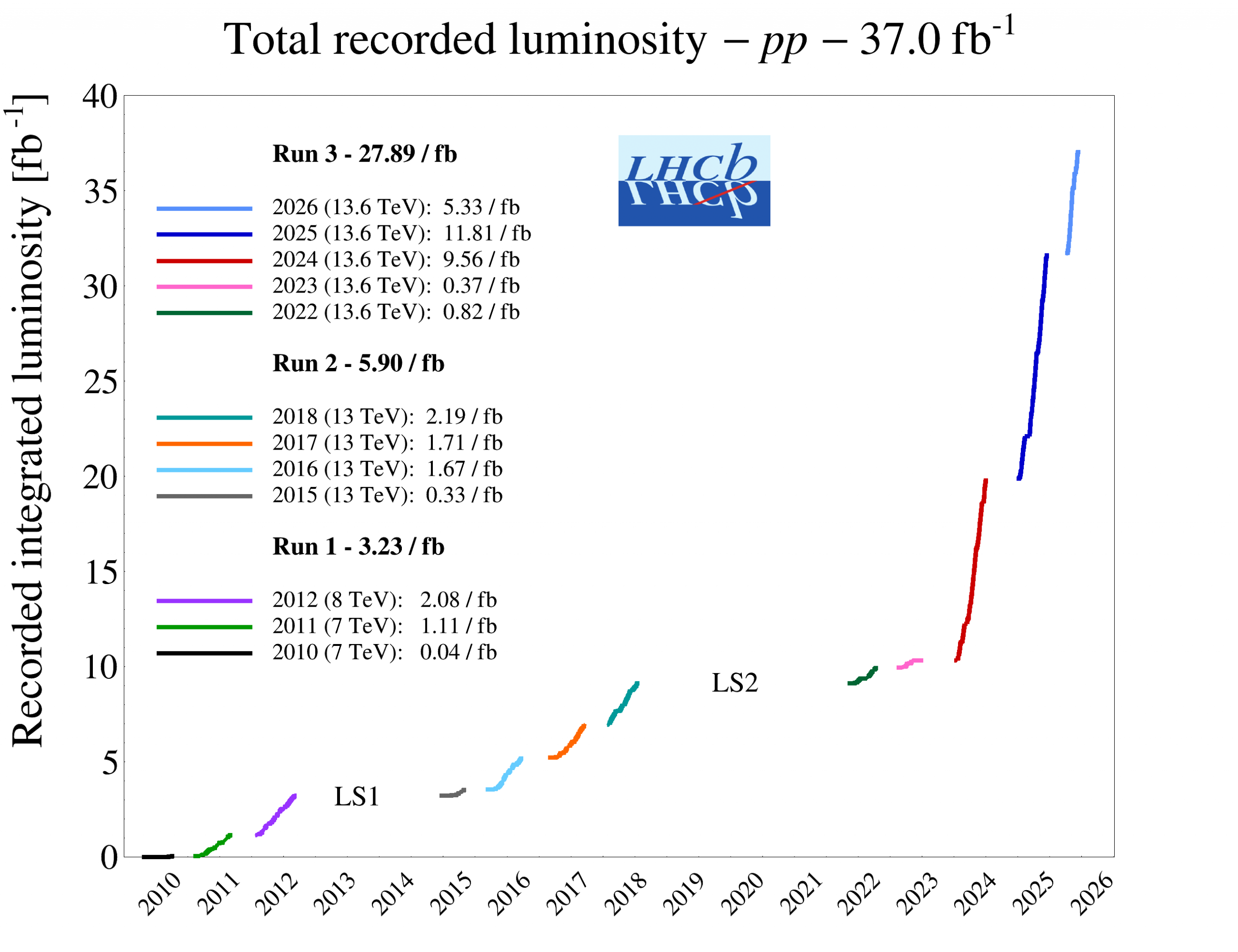
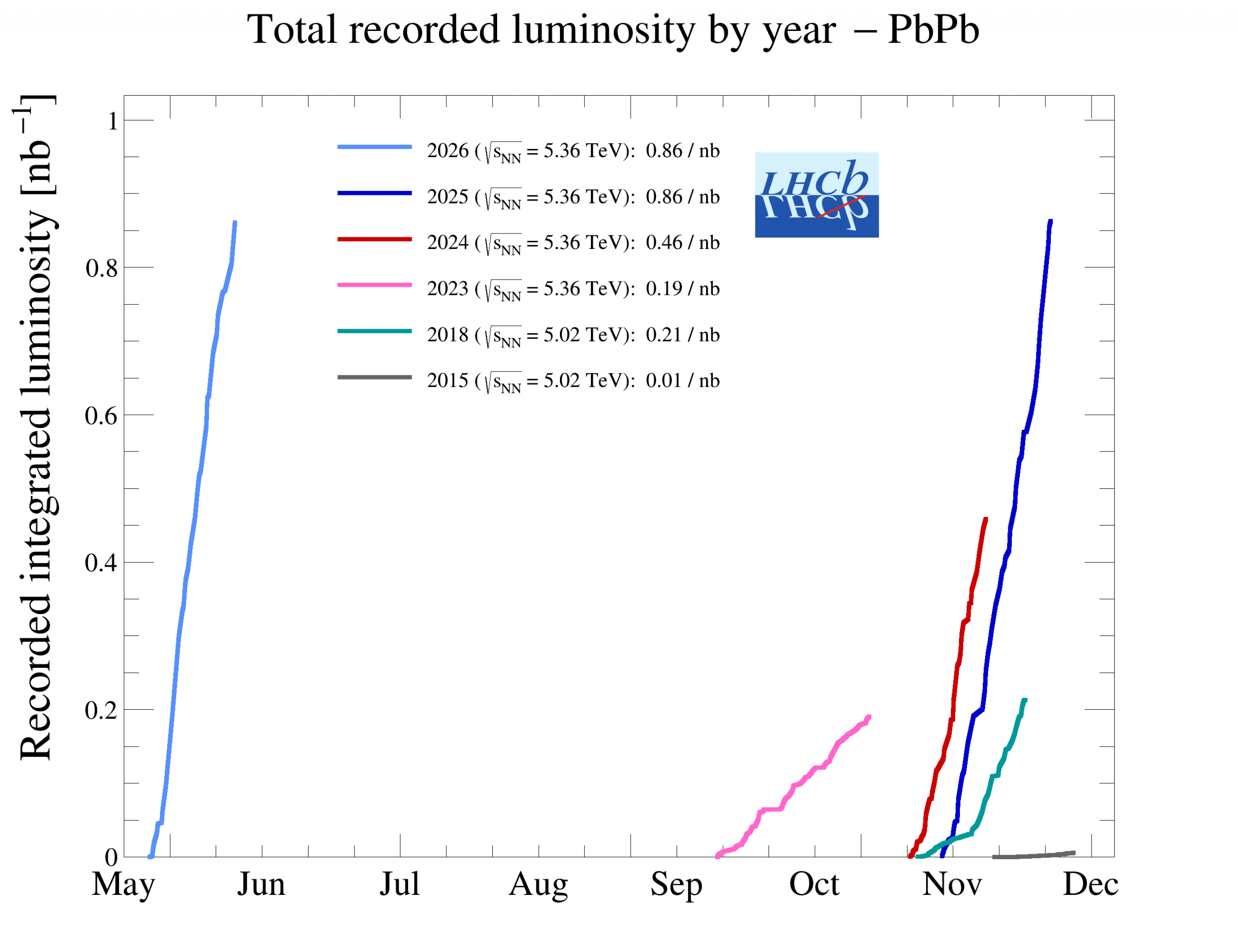
During Run 3, the experiment acquired an integrated luminosity of 28 fb-1 in protonproton collisions at a centre-of-mass energy of 13.6 TeV, bringing the total dataset to almost four times that collected in Runs 1 and 2 combined, as shown in the figures above. However, the gain in physics reach goes well beyond the increase in luminosity. One of the principal goals of the upgrade was to increase the statistical reach via the fully software-based event filtering, particularly for hadronic decay channels. The first Run 3 analyses demonstrate that this goal has been achieved, with typical signal yields increasing by a factor of eight compared with the entire Run 1 and 2 dataset, as illustrated in the figures below.
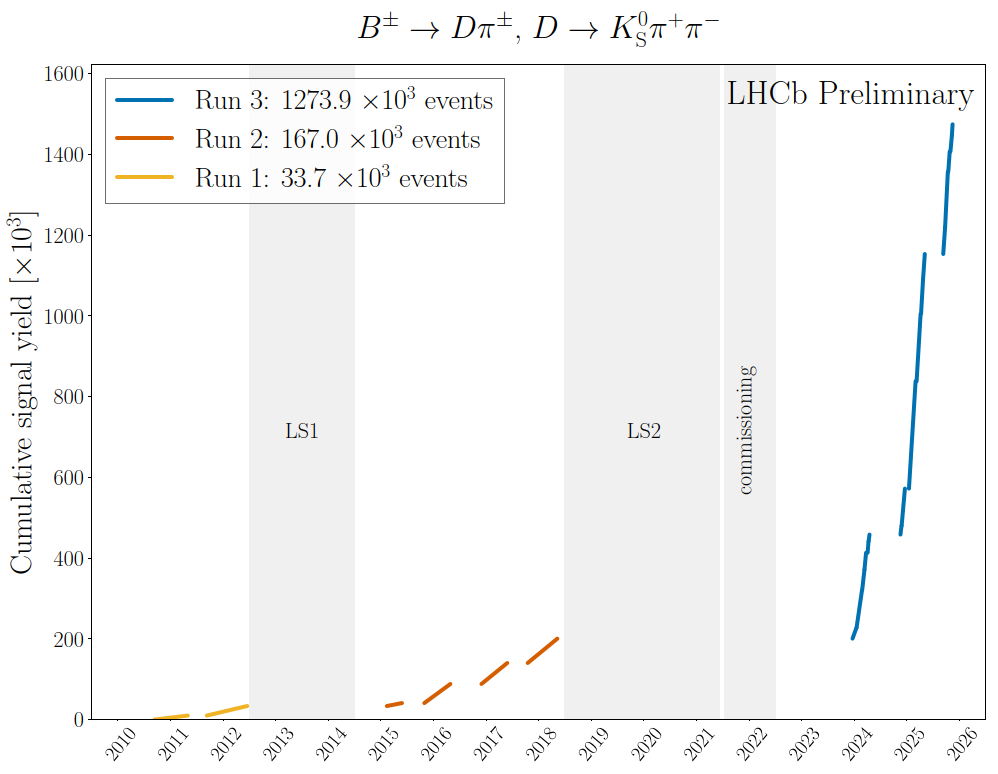
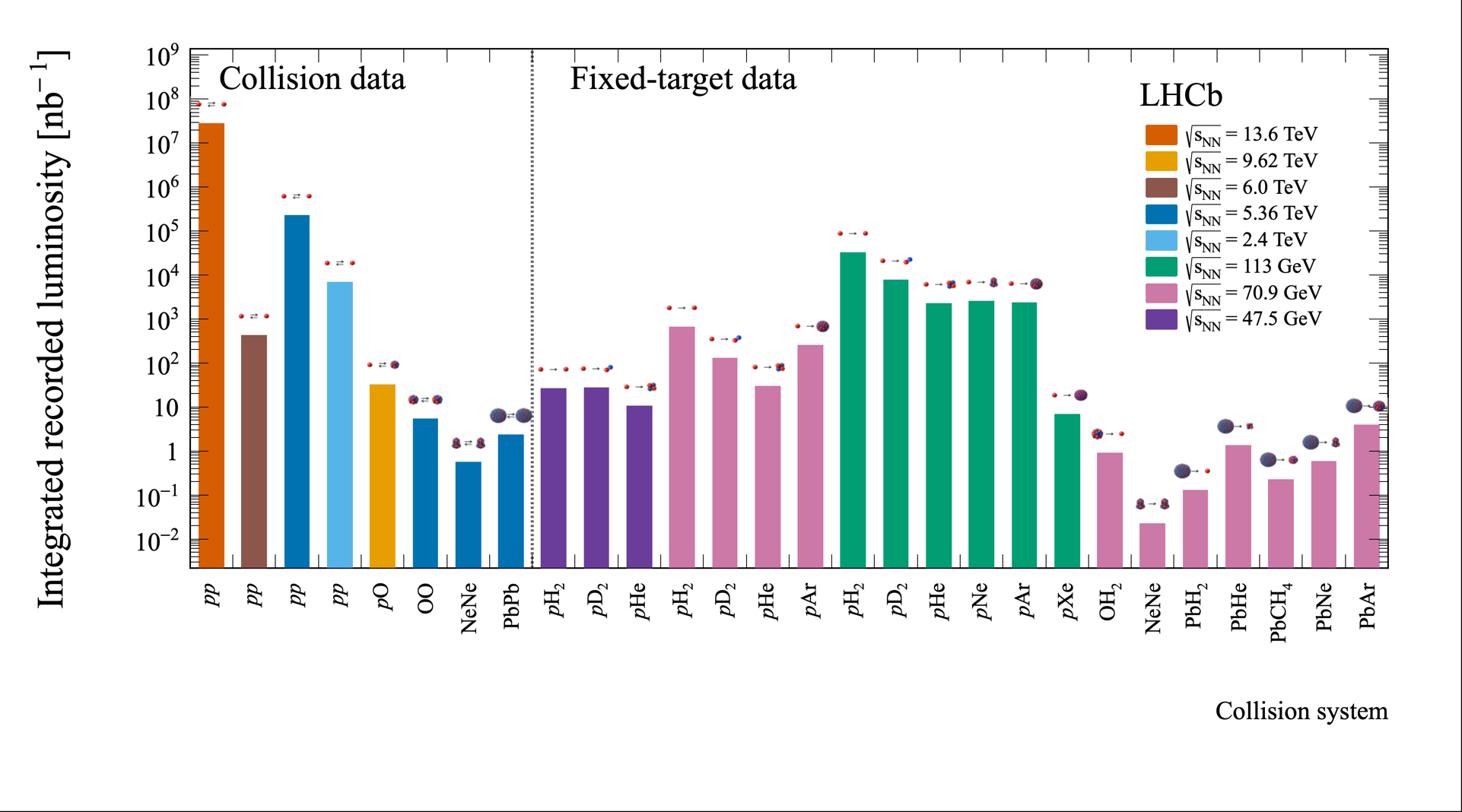
LHCb also acquired a record dataset in heavy-ion collisions, including a total of 2.6 nb-1 of lead-lead collisions, as well as oxygen-oxygen, neon-neon and proton-oxygen collisions. Important datasets were also collected at lower proton-proton centre-of-mass energies, providing, among other physics opportunities, valuable reference measurements for the heavy-ion programme. The SMOG2 system, which allows a wide variety of gases to be injected into the target cell, also enabled the collection of an unprecedented range of fixed-target collision datasets, as illustrated below.
Throughout this period, LHCb achieved very high data-taking efficiency, exceeding 92% in the final two years of operation, with more than 99% of the recorded data meeting the quality requirements for physics analysis. The Run 3 data-taking campaign represented an extraordinary human effort. More than 6500 shift slots were filled to provide 24/7 coverage by the central shift crew – the shift leader and data manager – responsible for the day-to-day running of the experiment. Behind them was a dedicated operational team on call around the clock, supporting 22 subsystems spanning detector hardware, software and computing infrastructure.
The collaboration now looks forward to exploiting the full physics potential of this dataset. In parallel, work in the cavern is already proceeding at full speed to install the LS3 enhancements — the first steps towards the Upgrade II detector, scheduled to begin data taking in Run 5.