

LHCb is celebrating the end of a very strong proton-proton run in 2026, during which the experiment benefitted from the stable and efficient running of the detector and the excellent LHC performance to collect 5.34 fb-1 of collision data. Almost all the data were taken at the highest LHC energy of 13.6 TeV. However, on April 30th, there was a pause in standard data taking to allow a highly anticipated low energy run for LHCb to go ahead.
This special 2-day run – at 1.2 TeV instead of 6.8 TeV per beam – enables a range of unique physics measurements. The primary goal is to provide crucial input into the interpretation of measurements of antimatter production in cosmic rays from space-borne experiments such as AMS and PAMELA. Deviations from the expected antimatter abundances can serve as a test for for the presence of Dark Matter. However, reducing cross-section uncertainties in the theoretical inputs is essential to verify that such observations cannot be explained by standard astrophysical processes.
LHCb will use the unique data from the low energy run to measure the rates of antiproton production when protons collide with hydrogen, deuterium, and helium targets. The relatively low energies compared to standard running can test the onset of mechanisms affecting antiproton production such as isospin asymmetry, strangeness enhancement and Bjorken scaling violations. In addition, a range of further physics measurements, including heavy flavour production, will be accessible in this largely unexplored kinematic domain.
These measurements rely on the LHCb SMOG2 system, a gas storage cell installed just in front of the LHCb VELO pixel vertex detector. SMOG2 allows simultaneous pp collision and fixed-target data taking using a wide choice of injectable gases, with data already acquired with hydrogen, deuterium, helium, neon, argon, and xenon. The programme also benefitted from the excellent performance of the upgraded LHCb detector, including the new SMOG2 cell, the VELO pixel detector, and the advanced fully software real-time event filtering system, which proved well adapted to the changing conditions of the special run.
A visual impression of the data taking conditions is shown below, displaying the online measurement, in log scale, of interaction vertices along the beamline (z coordinate), superposed on the mechanical layout of the SMOG2 cell (in blue), where the fixed-target events occur, and the VELO vertex detector (in green), which surrounds the pp collision region.
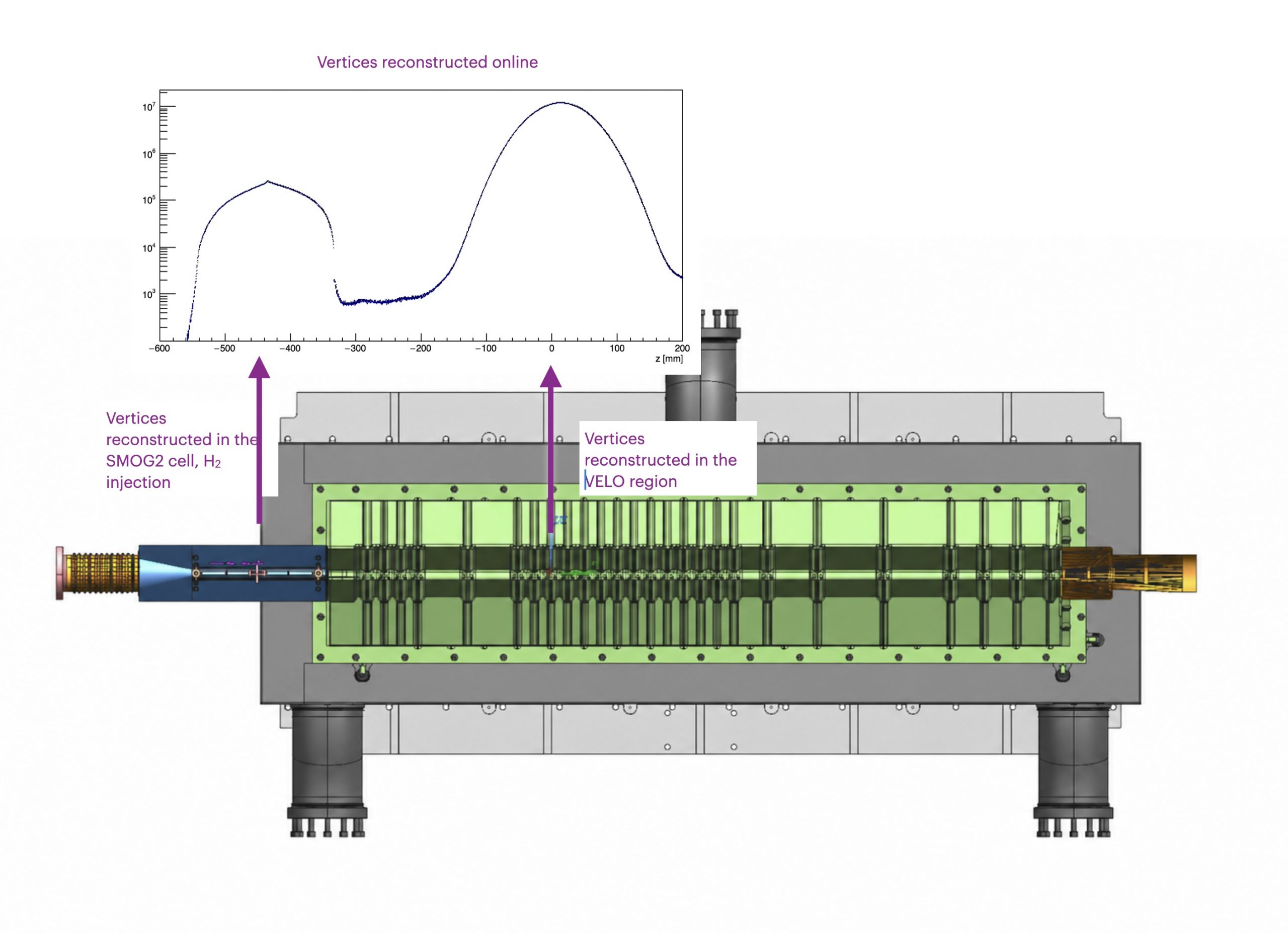
The low energy run presented multiple challenges for both the machine and the experiments, needing to be completed within just two days. It was effectively a miniature version of normal high energy running, compressing activities such as beam commissioning, experimental derivation of luminosity calibration cross-sections via “emittance scans”, and intensity ramp-up, which would typically span a longer period, into a very short timeframe. Finding the optimal beam configuration was particularly challenging, since low energy beam conditions differ significantly from normal running. Specific requirements for LHCb included a prompt gas bottle change to enable data acquisition with three different gases, as well as special VELO settings to provide sufficient aperture for the low energy beams.
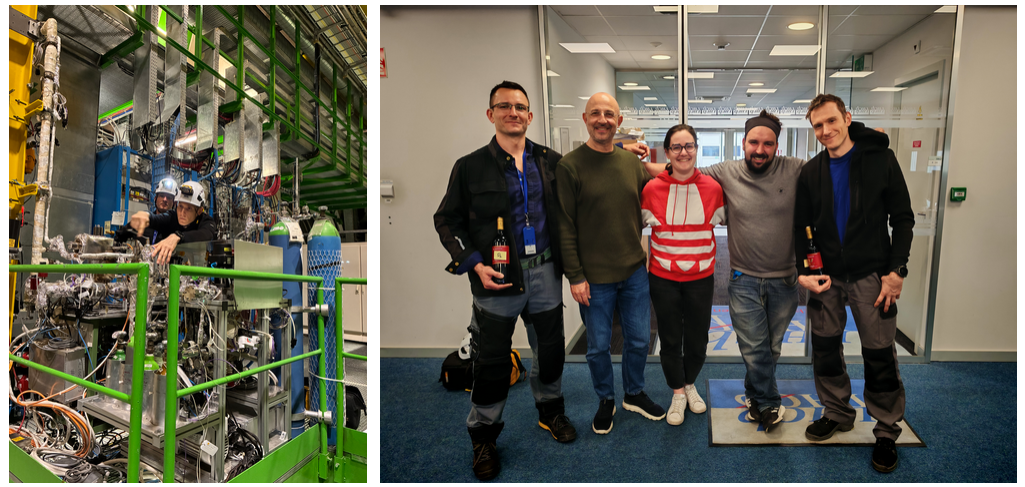
Photographs above show the TE-VSC team switching the hydrogen and deuterium bottles, and later celebrating with the LHCb SMOG team.
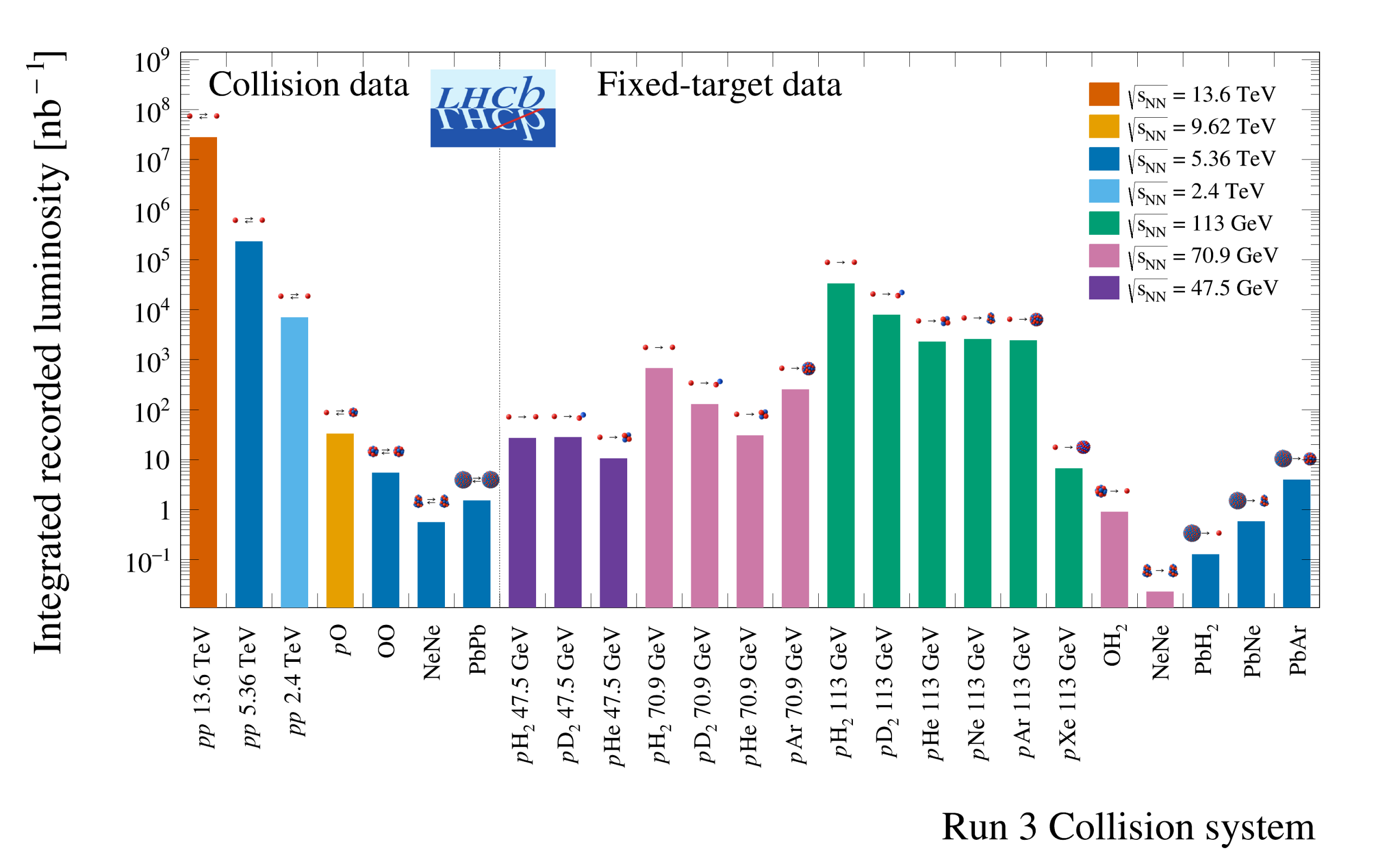
LHCb is delighted to report that all luminosity targets were reached over the course of five physics production fills, with more than one billion events recorded for each of the injected gases in the fixed-target programme, and an integrated recorded luminosity of 7 pb-1 in pp collisions. This low energy run adds three collision systems to the SMOG2 fixed target programme, and one collision system to the collider programme, bringing the number of LHCb collision systems in Run 3 so far to a grand total of 25. The preliminary integrated luminosities of all systems are illustrated in the figure below, colour-coded by energy.
The 1.2 TeV run was also used by ATLAS and CMS within their pp programmes to investigate collective phenomena and soft physics. In addition, the ATLAS Forward Proton (AFP) detector participated in data taking, extending its diffractive physics programme. As a feasibility study, ALICE tested a reduced-gain operating mode of the Time Projection Chamber (TPC) for the search for highly ionising particles.